
Ramayana for Kids: How to Tell It at Bedtime (Ages 4–7)
Sleepysaga Team · October 21, 2026
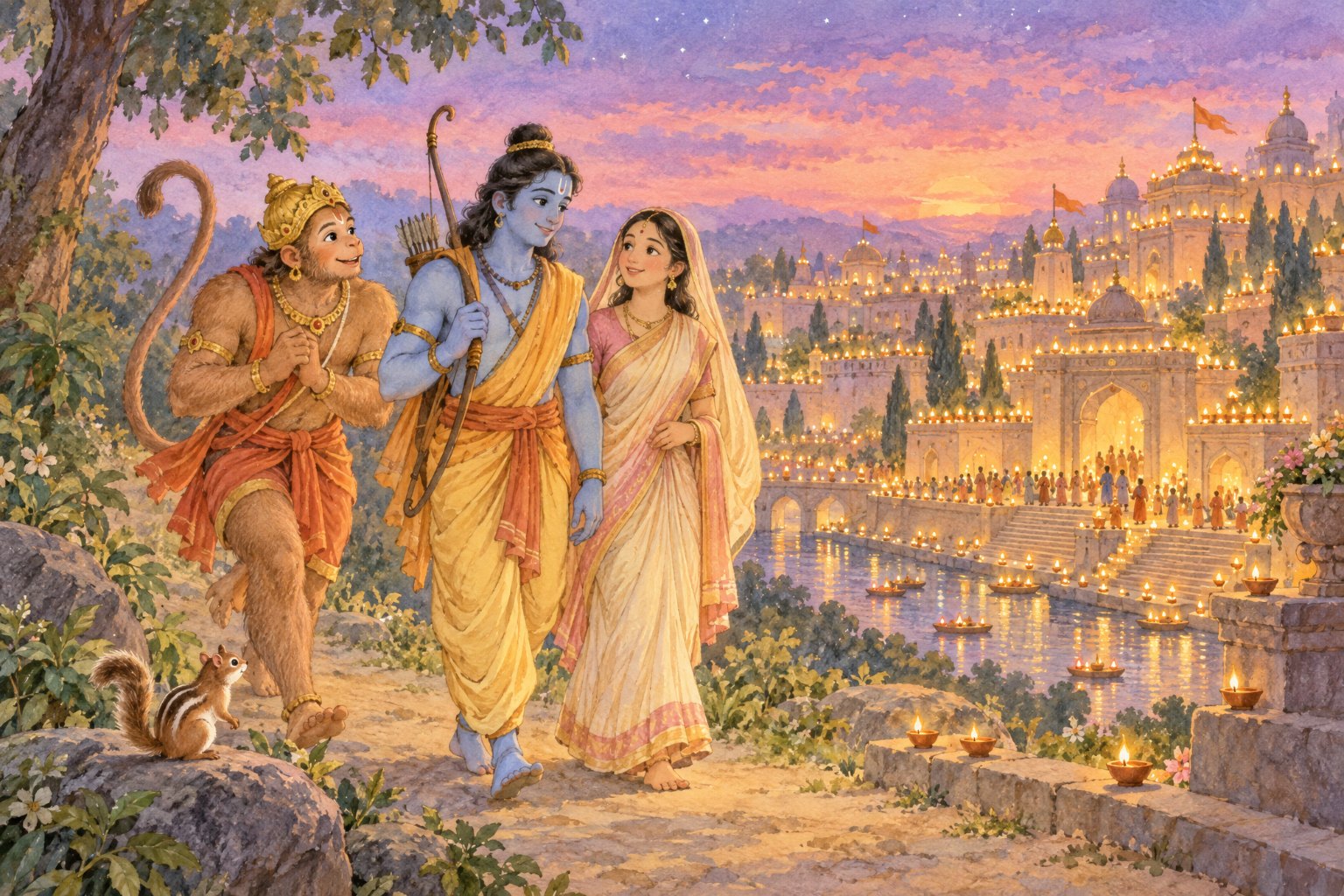
The Ramleela ground is packed. Your five-year-old is on your shoulders, eyes huge, watching Ravana's giant effigy tower over the crowd — ten painted faces, a fierce moustache on every one. When the arrow strikes and the fireworks go off, everyone cheers.
That night, at 1 a.m., a small voice in the dark: "Is Ravana dead for real? Can he come to our house?"
The Ramayana is one of the most beautiful stories you can give a child — about keeping promises, loving your family, being brave for others, and coming home. But told all at once, or with the wrong details at the wrong time, it can also be one of the scariest.
The short answer: to tell the Ramayana to a 4–7-year-old at bedtime, tell it in short episodes over many nights. Focus on the parts about courage, loyalty and friendship — Hanuman, Jatayu, the little squirrel, and the homecoming to Ayodhya. Keep the battle and Ravana brief and gentle. And save frightening images, like ten heads or shape-changing demons, for daytime — because at this age, how a character looks frightens children far more than what the story says about them.
Simplifying the Ramayana is part of the tradition
Some parents worry that leaving parts out is disrespectful. It isn't — the Ramayana has always been told in many ways.
Valmiki's Sanskrit Ramayana — probably composed in the middle centuries of the first millennium BCE and shaped over a long time — has around 24,000 couplets in seven books (kandas): Bala, Ayodhya, Aranya, Kishkindha, Sundara, Yuddha and Uttara. Many scholars consider the last of these, the Uttara Kanda, to be a later addition.[1] In the 16th century, Tulsidas retold the story in Awadhi as the Ramcharitmanas, the version many North Indian families know best.[2] Kambar told it in Tamil, and versions such as Cambodia's Reamker and Thailand's Ramakien carried it across Southeast Asia.[3]
The scholar A. K. Ramanujan famously wrote of "three hundred Ramayanas" — the idea that there isn't one fixed telling, but many, each shaped by who is telling it and to whom.[4] A parent choosing which parts to tell a five-year-old is doing exactly what storytellers have always done.
Why some parts are hard for young children
Children aged roughly 3 to 7 are most frightened by fantasy characters, transformations, and violence between people.[5] Media researcher Joanne Cantor found that for preschoolers, "how something looks is the most important determinant of whether it will be scary."[6]
Now think about the Ramayana: a ten-headed king, rakshasas, a demon who turns into a golden deer, a long war. These are exactly the things young children find hardest to shake off at night. The story isn't too scary — but some of its images are, at this age and at this time of day.
A Ramayana episode guide for ages 4–7
Tell these at bedtime
- The birth of the four princes and Rama's childhood — four brothers, a loving family, a happy kingdom.
- Breaking Shiva's bow, and Rama and Sita's wedding — gentle strength and a joyful celebration.
- The exile to the forest — tell it gently: Rama keeps his father's promise. Reassure your child that the family is together again at the end.
- Bharata and the sandals — a brother's love and loyalty.
- Shabari's berries — love matters more than perfect gifts.
- Jatayu — a brave old bird who helped even when it was hard.
- Hanuman finds Sita; the squirrel and the bridge — the best parts for this age: courage, teamwork, and how even small helpers matter.
- The return to Ayodhya and Diwali — the perfect ending, with lamps lit across a whole city to welcome them home.
Tell these briefly (or in daytime)
- Shurpanakha — skip the details: "Ravana's sister was sent away, and she was very angry."
- The golden deer and Sita being taken away — skip the shape-changing, and move quickly to "and help was on its way."
- The battle in Lanka — "Rama won, and Sita came home" is enough. No battle details at bedtime.
Save these for later
- The Agni Pariksha and Sita's later exile (Uttara Kanda) — complex, grown-up themes for when your child is much older.
What to do
Tell it in episodes. The Ramayana is far too long for one night — and it doesn't need to be told in one. One episode a night turns it into something your child looks forward to.
Put the helpers at the centre. For a young child, the heart of the Ramayana is the friends who help: Lakshmana, Hanuman, Jatayu, Sugriva, the squirrel. These are the characters young children relate to, and their stories are full of courage without being frightening.
Describe Ravana by his choices, not his looks. Instead of ten heads and fierce eyes, try: "Ravana was a very clever, very strong king — but he became so proud that he forgot how to be good." A character who made a wrong choice is much less frightening than a monster.
Keep the battle offstage. "There was a great battle, and Rama won" is enough at this age.
End every night somewhere safe. If you stop mid-story, stop at a calm moment — Hanuman reaching Sita, the bridge being built — not at the abduction.
Prepare your child for Ramleela and Dussehra. Before the outing, explain that the effigy is a giant model made of paper and bamboo, and that burning it is a way of celebrating good winning over bad. If your child is still scared, Cantor's research suggests that for preschoolers, comfort works better than explanation: a cuddle, your calm voice, and staying close.[6]
What not to do
Don't start with the abduction or the war. Begin in Ayodhya, with the family. A child who already loves Rama, Sita and Hanuman will follow them through the harder parts.
Don't describe Ravana's appearance in vivid detail at bedtime. Save the ten heads for daytime picture books and festival talk.
Don't tell the Uttara Kanda yet. Sita's trial by fire and later exile raise questions about fairness and trust that are hard even for adults. They'll mean more when your child is older.
Don't worry about "getting it right". Your grandmother told it one way, a TV serial another, your child's school another. That variety is part of the Ramayana.
Ramayana stories on Sleepy Saga
- Lord Rama's Tales — twelve short chapters that follow this gentle approach, from The Four Little Princes of Ayodhya to The Night of a Thousand Lamps. The battle happens "like a storm far away," and the story ends with the whole city glowing to welcome Rama home. Chapters like The Sweetest Berries in the Forest (Shabari) and The Littlest Paws on the Big Bridge (the squirrel) are ideal bedtime episodes.
- Ramleela Nights — nine chapters for the nine nights of Navratri, ending on Dussehra. Read one each night alongside the Ramleela in your town.
- Hanuman Tales — the favourite helper's own adventures, full of courage and self-belief.
All three are available in Hindi as well as English — perfect for Ramayan ki kahani at bedtime in whichever language your family prefers.
Try this tonight. Tell just one episode — the squirrel helping to build the bridge is a lovely place to start. Then ask: "What small thing could you do to help someone tomorrow?"
Frequently asked questions
How do I explain the Ramayana to a 5-year-old?
Tell it in short episodes over several nights. Start with the four princes in Ayodhya, focus on the friends who help Rama — Hanuman, Jatayu and the squirrel — keep Ravana and the battle brief, and end with the lamps of Diwali welcoming everyone home.
Is the Ramayana too violent for young children?
The full story includes a war and some frightening characters, but the Ramayana can easily be told gently. For ages 4–7, keep the battle very brief, avoid vivid descriptions of Ravana and the rakshasas, and save the Uttara Kanda for later.
How many kandas are in the Ramayana?
Valmiki's Ramayana has seven kandas: Bala, Ayodhya, Aranya, Kishkindha, Sundara, Yuddha and Uttara. Tulsidas's Ramcharitmanas also has seven, with the sixth called Lanka Kanda.
How do I explain Ravana without scaring my child?
Describe him by his choices rather than his appearance: a clever, powerful king who became so proud that he forgot to be good. A character who made a wrong choice is far less frightening for a young child than a monster.
Where can I find short Ramayana stories in Hindi for kids?
Sleepy Saga's Lord Rama's Tales and Ramleela Nights are written for bedtime and are available in both Hindi and English.
Related reading
- Hanuman Stories for Children: 7 Adventures and Their Lessons — the Ramayana's best-loved helper.
- Best Krishna Stories for Kids (and What Each One Teaches) — more gentle mythology for bedtime.
- Bedtime Stories for 3-Year-Olds: What to Pick & Skip — why scary-looking characters affect young children so strongly.
Sources & further reading
- Encyclopaedia Britannica. How is the Ramayana structured? See also Britannica: Ramayana.
- Encyclopaedia Britannica. Tulsidas.
- Encyclopaedia Britannica. Reamker.
- Ramanujan, A. K. (1991). Three Hundred Rāmāyaṇas: Five Examples and Three Thoughts on Translation. In P. Richman (Ed.), Many Rāmāyaṇas: The Diversity of a Narrative Tradition in South Asia. University of California Press.
- Custers, K., & Van den Bulck, J. (2012). Clinical practice: Fear effects by the media. European Journal of Pediatrics, 171(4), 613–616.
- Cantor, J. Children's Fright Responses to Television and Films. University of Wisconsin.
Want more articles like this, every week?
Research-backed parenting tips, straight to your inbox. No spam, unsubscribe anytime.