
Bedtime Stories for 3-Year-Olds: What to Pick & Skip
Sleepysaga Team · October 21, 2026
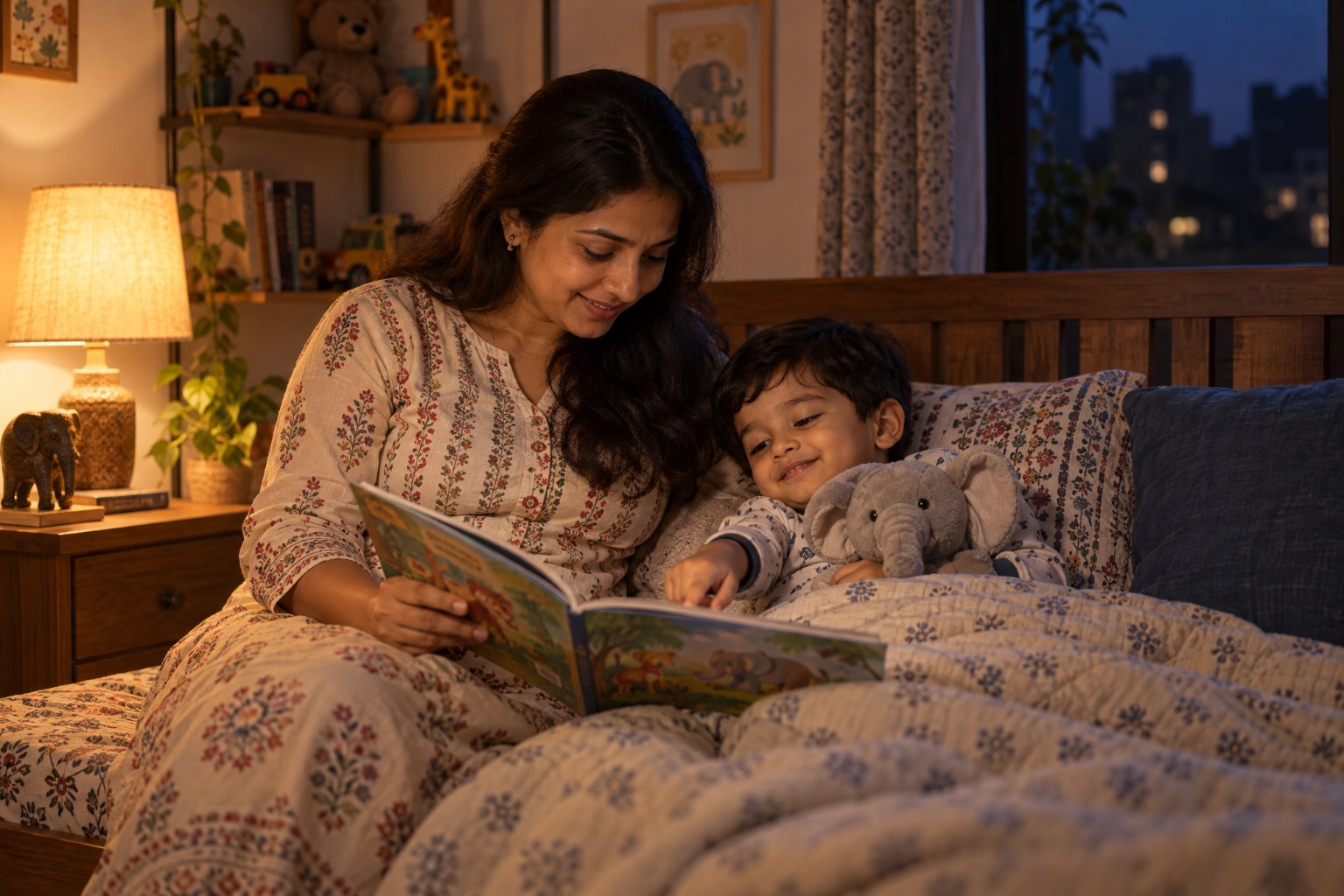
It's 10:15 p.m. Your three-year-old is finally in bed, and Dadi has offered to tell the story tonight. She picks a favourite from her own childhood — the one about the chudail in the peepal tree. Your child listens wide-eyed, perfectly still. It looks like it's working.
At 2 a.m., there are small feet running down the hallway. "There's something in the tree outside."
Nobody did anything wrong. Dadi told a story she loved, the way it was told to her. But that one night captures most of what matters when you choose a bedtime story for a three-year-old.
The short answer: the best bedtime stories for 3-year-olds are short (a few hundred words), built on repetition or rhyme, centred on one or two familiar characters, calm in tone, and read in a parent's voice. Skip anything with scary-looking creatures, chases or high excitement right before lights-out — at this age, what a character looks like frightens children far more than what the story says about it.
Why choosing the story matters at three
Three is a pivot year. Your child understands far more language than they did at two and can follow a simple plot from start to end. But the brain machinery that sorts "real" from "pretend" is still under construction, and so is their ability to calm themselves down once they're frightened.
Bedtime is also when they need to wind down, not wind up. The American Academy of Sleep Medicine recommends 10 to 13 hours of sleep per day, including naps, for children aged 3 to 5.[1] That's a lot of sleep to fit in — especially in India, where one multi-country study found the latest average preschool bedtime of any country surveyed: 10:26 p.m., compared with 7:43 p.m. in Australia and New Zealand.[2] When bedtime is already late, the story has to be the kind that helps a child drift off, not the kind that keeps them awake.
What actually scares a 3-year-old
This is the part most "best bedtime stories" lists skip, and it's the most useful thing to know.
Media researcher Joanne Cantor spent years studying what frightens children at different ages. Her consistent finding: for preschoolers, "how something looks is the most important determinant of whether it will be scary."[3] Only from around age eight do children start weighing a character's motives over its appearance. A gentle creature with a scary face can upset a young child more than a story about a real danger described in calm words. A clinical review in the European Journal of Pediatrics sums it up: children aged roughly 3 to 7 are most afraid of fantasy characters, transformations, and interpersonal violence.[4]
That explains the 2 a.m. visit. A chudail, a bhoot, a monster that changes shape — these are exactly the images a three-year-old can't shake off.
It's also common. In a study of children aged 3 to 10 at PGIMER Chandigarh, 34% were afraid of sleeping in the dark, with darkness, ghosts and lizards among the most-named fears.[5] (It was a small clinic sample, but it rings true for many Indian homes.)
There's a thinking-skills reason too. Most children only begin to understand that someone can believe something false — the basis of every "trick" plot — at around age four.[6] So a story where a fox fools the hen, or a character pretends to be someone else, can simply confuse a three-year-old.
What to look for in a bedtime story for a 3-year-old
Keep it short — a few hundred words. A study of popular children's books found that a typical picture book contains only around 200 words, and a board book even fewer.[7] That's the natural length for this age: about three to five minutes read slowly, with pauses to look at pictures.
Choose repetition and rhyme. Refrains like "Not I," said the duck. "Not I," said the cat give your child a part to "read" along with you. Predictability feels safe, and safe is what you want at bedtime.
One or two characters, one simple problem. A small cast in a familiar setting — home, garden, kitchen, a meadow — is easy to follow, even for a sleepy child.
Read it again. And again. If your child asks for the same book every night, say yes. In a University of Sussex study, three-year-olds who heard the same stories repeatedly learned more new words than children who heard different stories with the same words in them.[8] Repetition isn't boredom for a toddler — it's mastery.
Talk while you read. Point to a picture and ask "What's that?" or "What do you think happens next?" This is called dialogic reading, and the evidence for it is strong. A meta-analysis found it boosted children's expressive vocabulary more than ordinary reading-aloud, with the biggest effect for children aged two to three.[9] A wider review of 19 randomised trials found that shared picture-book reading improves young children's language.[10] At bedtime, keep the questions few and soft — two or three, not a quiz.
End on safety and sleep. The best bedtime stories for toddlers land somewhere calm: home, a cuddle, everyone asleep. The last picture in your child's head is the one they take to bed.
What to skip at bedtime
Scary-looking creatures, even friendly ones. Ghosts, witches, monsters, shape-shifters and rakshasas — however kind they turn out to be — are best saved for daytime at this age.
Chases and "the wolf is coming" moments. The Gingerbread Man and The Three Little Pigs are wonderful stories. They just work better after breakfast than after brushing teeth.
Trick-based plots. If the whole story hinges on someone being fooled, your three-year-old may follow the action but miss the point. Save these for four and up.
"It's only pretend" as your fix for fear. Cantor's research found that preschoolers are helped mainly by "physical comfort, warmth, and closeness" — a cuddle, a comfort toy, your calm voice.[3] Reminders that something isn't real work much better with school-age children.
Animated or "enhanced" e-books. In a study published in Pediatrics, toddlers and parents talked less and collaborated less when reading an electronic book with sounds and animation than when reading a print book together.[11] If you read from a phone, use it as a page — screen turned away, brightness down, your voice doing the work.
Sleepy Saga stories made for this age
Looking for short bedtime stories for toddlers in English or Hindi (bachchon ki kahaniyan)? Our Toddler (3–5) shelf is built around exactly these principles: short chapters, gentle sounds, small casts, soft endings.
- Pip the Listening Mouse — a tiny field mouse collects the softest sounds in the meadow to sing his tired mum to sleep. Each chapter is one gentle place and a few gentle sounds, and the series ends with The Nighttime Lullaby, where every sound from Pip's journey tucks him into bed. For a child who's nervous about the dark, The Dark and Cozy Cave turns a dark place into a friendly one: Pip listens to echoes and trickling water and finds a sleepy baby bat whose yawn is catching.
- Adventures with Dr. Jojo — in Milo and the Monster Under the Bed, the scratching under the bed turns out to be a wind-up penguin dragging a striped sock. Because no monster ever appears, it's a good one for a child who already has night fears. Read it in the daytime first, then at bedtime once it feels familiar.
- The Little Red Hen — the classic "Not I!" refrain is the repetition toddlers love, and they'll soon be saying it with you.
- Krishna's Tales — the butter-thief stories are cheerful and mischievous, with no frightening imagery. Start with The Butter Thief of Vrindavan and The Flute That Called Everyone Home, and save the chapters with demons and villains for when your child is older.
Many of our stories, including Pip, also come in Hindi, so Dadi can still be the storyteller — just with a gentler script.
Try this tonight. Pick one short story, dim the lights, and read it slowly. Ask one question halfway through. If your child asks for it again tomorrow, read it again. That's the whole method.
Frequently asked questions
What kind of bedtime story is best for a 3-year-old?
A short story (a few hundred words) with repetition or rhyme, one or two characters, a simple problem, and a calm, reassuring ending. Animals, family, home and nature are ideal settings. Avoid anything with frightening-looking characters right before sleep.
How long should a bedtime story be for a 3-year-old?
About three to five minutes. A typical picture book has around 200 words, which takes just a few minutes to read slowly. One or two short books — or one chapter of a gentle series — is plenty.
Is it okay to read the same bedtime story every night?
Yes, and it helps. Research with three-year-olds found that hearing the same stories repeatedly led to more word learning than hearing different stories. Familiar stories also feel safe, which supports sleep.
My 3-year-old got scared after a story. What should I do?
Comfort first, explanations later. At this age, a cuddle, a favourite toy, a night light and your calm voice work better than "it's not real." Next time, choose stories without scary-looking characters for bedtime and save those for daytime.
Related reading
- The 10 Minutes That Matter Most — Why Your Voice Beats Any Screen at Bedtime — why the story matters as much as the sleep.
- Your Toddler Isn't Being Bad. Their Brain Just Isn't Finished Yet. — what's happening in a toddler's brain, and why calm evenings help.
- Best Krishna Stories for Kids (and What Each One Teaches) — gentle mythology to start with.
Sources & further reading
- Paruthi, S., et al. (2016). Recommended Amount of Sleep for Pediatric Populations: A Consensus Statement of the American Academy of Sleep Medicine. Journal of Clinical Sleep Medicine, 12(6), 785–786.
- Mindell, J. A., Sadeh, A., Kwon, R., & Goh, D. Y. (2013). Cross-cultural differences in the sleep of preschool children. Sleep Medicine, 14(12), 1283–1289.
- Cantor, J. Children's Fright Responses to Television and Films (summary of her research programme, University of Wisconsin). See also Cantor, J., & Wilson, B. J. (1988). Helping children cope with frightening media presentations. Current Psychology: Research & Reviews, 7(1), 58–75.
- Custers, K., & Van den Bulck, J. (2012). Clinical practice: Fear effects by the media. European Journal of Pediatrics, 171(4), 613–616.
- Bharti, B., Malhi, P., & Kashyap, S. (2006). Patterns and problems of sleep in school going children. Indian Pediatrics, 43, 35–38.
- Wellman, H. M., Cross, D., & Watson, J. (2001). Meta-analysis of theory-of-mind development: The truth about false belief. Child Development, 72(3), 655–684.
- Logan, J. A. R., Justice, L. M., Yumuş, M., & Chaparro-Moreno, L. J. (2019). When children are not read to at home: The million word gap. Journal of Developmental & Behavioral Pediatrics, 40(5), 383–386.
- Horst, J. S., Parsons, K. L., & Bryan, N. M. (2011). Get the story straight: Contextual repetition promotes word learning from storybooks. Frontiers in Psychology, 2, 17.
- Mol, S. E., Bus, A. G., de Jong, M. T., & Smeets, D. J. H. (2008). Added value of dialogic parent–child book readings: A meta-analysis. Early Education and Development, 19(1), 7–26.
- Dowdall, N., et al. (2020). Shared picture book reading interventions for child language development: A systematic review and meta-analysis. Child Development, 91(2), e383–e399.
- Munzer, T. G., Miller, A. L., Weeks, H. M., Kaciroti, N., & Radesky, J. (2019). Differences in parent-toddler interactions with electronic versus print books. Pediatrics, 143(4), e20182012.
Want more articles like this, every week?
Research-backed parenting tips, straight to your inbox. No spam, unsubscribe anytime.