
Best Krishna Stories for Kids (and What Each One Teaches)
Sleepysaga Team · August 29, 2026
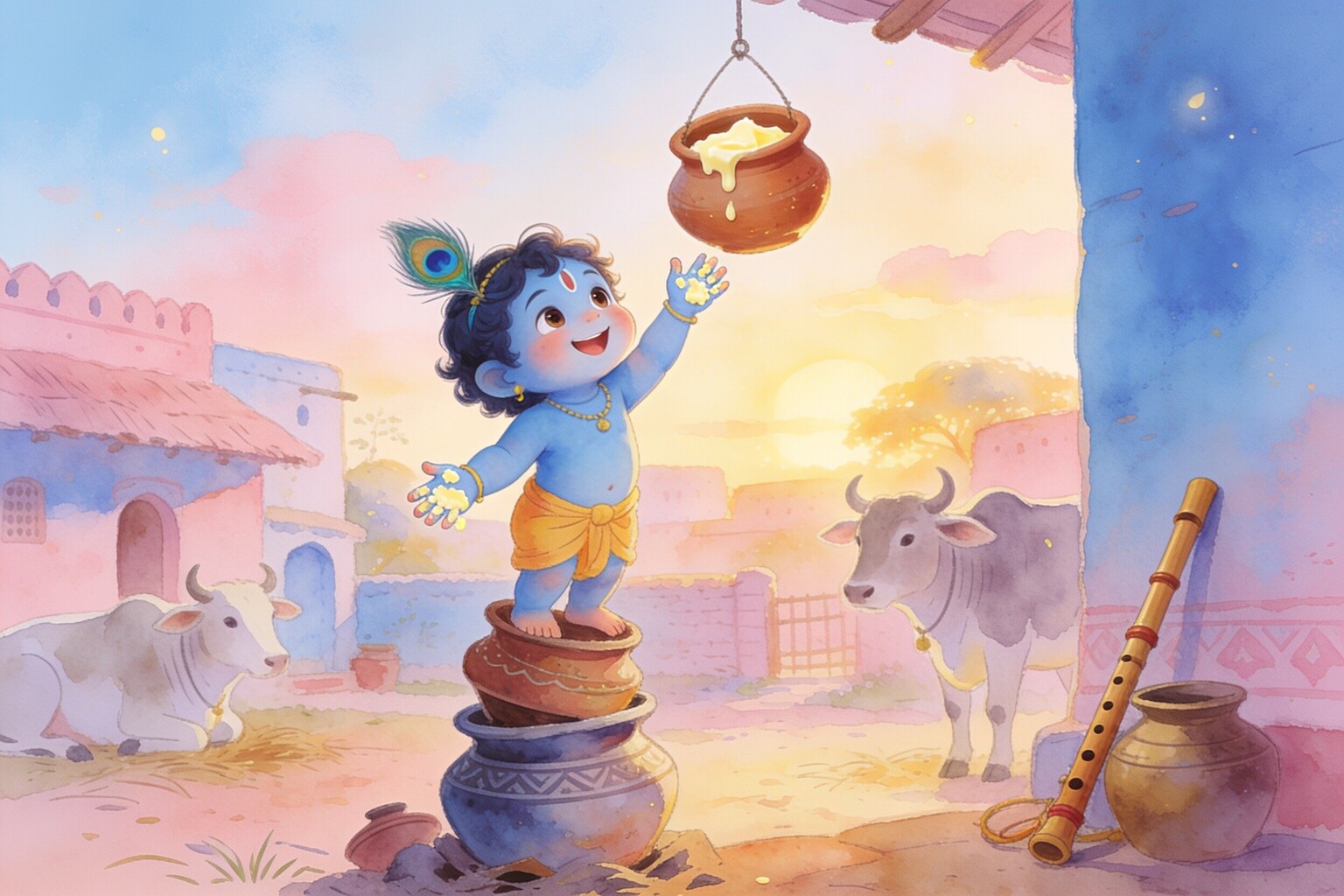
Ask any Indian grandparent for a bedtime story and odds are good you'll get Krishna. The toddler with butter on his hands. The boy dancing on a serpent's hoods. The king who wept with joy over a handful of flattened rice.
These stories have survived thousands of years of retelling for a reason — Krishna is one of the most beloved figures in all of Indian tradition, worshipped as the eighth avatar of Vishnu and celebrated most of all through the playful stories of his childhood.[1] But here's what makes them special for parents: almost every Krishna story carries a lesson a young child can actually use, wrapped in enough mischief that they never notice they're being taught.
Why stories teach better than lectures
Before the list, one piece of research worth knowing. Studies with preschoolers consistently find that moral stories genuinely shift behavior — children who hear stories where a character makes a good choice become measurably more honest and more willing to share afterward.[2]
There's a catch, though: the effect is strongest when a child is invited to be like the character, not just told the moral.[3] So after each story below, skip "and the moral of the story is…" and try "What would you have done?" instead. That one question is where the lesson actually lands.
The stories, and what each one teaches
1. The Butter Thief of Vrindavan
Toddler Krishna and his friends stack pots and stools into wobbly towers to reach the butter Yashoda has hidden high on a shelf — and leave a trail of sticky little handprints behind them.
What it teaches: joy, honesty, and owning up. Krishna gets caught every single time, and the story lets kids laugh at mischief while watching what it looks like to face a parent afterward. It's also simply the best entry point — if your child meets only one Krishna story, it's this one.
2. The Whole Universe in a Little Mouth
Yashoda hears that little Krishna has been eating dirt and asks him to open his mouth. Inside, for one dizzying moment, she sees the entire universe — stars, rivers, mountains, everything.
What it teaches: there is more to every person than what we see, even the small ones. For children, it lands as wonder. For the parent reading it aloud, it's quietly moving — a reminder that the child in front of you contains more than you know.
3. Krishna and Kaliya, the Serpent King
The serpent Kaliya has poisoned the Yamuna river. Krishna dives in — but instead of destroying him, he dances across Kaliya's many hoods until the serpent yields, then sends him away with mercy.
What it teaches: courage doesn't have to be cruel. Krishna wins without hatred, and Kaliya is allowed to leave with his family. It's one of the gentlest ways to show a child that standing up to something scary and being kind are not opposites.
4. The Mountain Umbrella (Govardhan Hill)
When proud Indra floods Vrindavan with storms, young Krishna lifts Govardhan Hill on one finger and holds it like an umbrella for seven days, sheltering every villager and every cow.
What it teaches: real strength protects. The strongest one in the story uses all that power just to keep others dry. For a child sorting out playground power dynamics, this is the lesson — being strong is for sheltering people, not for towering over them.
5. The Flute That Called Everyone Home
Every evening, Krishna's flute drifts across Vrindavan, and everyone — friends, family, cows, birds — stops what they're doing and comes together to dance beneath the moon.
What it teaches: presence and togetherness. Nothing is defeated in this story and nothing is won. It teaches a child that gathering the people you love at the end of the day is the point — which makes it, not incidentally, a perfect last story of the night.
6. A King Remembers His Friend (Krishna and Sudama)
Sudama, Krishna's childhood friend, is now poor. He walks to the golden city of Dwarka with nothing to offer but a small bundle of flattened rice — and King Krishna receives him with open arms and delight, treasuring the humble gift.
What it teaches: friendship is not about what someone has. Krishna the king and Sudama the poor Brahmin sit together as equals because they were friends first. This is the classic answer to early playground status-sorting — worth telling the week someone at school starts comparing toys.
7. A Baby Crosses a Stormy River
On the night Krishna is born in Kamsa's prison, his father Vasudeva carries the newborn across the flooding Yamuna in a basket, while the great serpent Shesha spreads his hoods overhead to shield the baby from the rain.
What it teaches: love does hard things quietly. It's a story about a parent walking through a storm for a child — children hear adventure, but they also absorb the deeper message that they are protected, which is exactly the feeling you want in the room at lights-out.
8. The Charioteer's Quiet Courage
Years later, on his friend Arjuna's hardest day, Krishna takes the humblest job on the battlefield — holding the reins of his friend's chariot — and offers him calm words about courage and doing what's right even when it's hard.
What it teaches: showing up for a friend, and doing your duty even when you're afraid. For a young child this doesn't need the philosophy — it's simply the story of the greatest hero choosing to be a helper.
How to tell them at bedtime
Krishna stories were made for serialization — one story a night, each complete in itself, in roughly the order of his life. Keep the scary bits soft (Kaliya yields, nobody is destroyed), let the funny bits be funny, and end each one with a question rather than a moral.
If you'd rather have them told for you, our Krishna's Tales collection retells thirteen of these stories — from the stormy river crossing to the charioteer's quiet courage — in gentle, bedtime-paced language, in both English and Hindi, and it's free to read.
Frequently asked questions about Krishna stories for kids
What age are Krishna stories appropriate for?
The childhood stories — the butter thief, the flute, the universe in his mouth — work from around age 3. Stories with mild peril, like Kaliya or the wrestlers of Mathura, land better from 5 up, especially in retellings where the resolution is merciful rather than violent. The Gita-era stories work best as simple friendship-and-courage tales until a child is much older.
Which Krishna story should I start with?
The Butter Thief. It's short, funny, needs no background, and stars a toddler being a toddler. Once your child loves the character, every other story has a built-in audience.
Do Krishna stories actually teach values, or is that wishful thinking?
Research on moral stories with preschoolers shows real, measurable effects — children who hear stories where characters make good choices behave more honestly and share more afterward. The effect is strongest when you invite your child to imagine being the character, rather than announcing the moral at the end.
Are these stories only for religious families?
No. Like Greek myths or Aesop's fables, Krishna stories work simply as great stories — a mischievous hero, vivid villains, and endings that reward courage and kindness. Families connect with them at whatever level fits: as culture, as faith, or just as wonderful bedtime material.
What's the best time to tell these stories?
Bedtime, for a practical reason: most Krishna stories end in safety, celebration, or reunion, which is the emotional note you want before sleep. Save the more exciting ones — Kaliya, the wrestlers — for earlier in the evening, and end the night with the flute calling everyone home.
Related reading
- Hanuman Stories for Children: 7 Adventures and Their Lessons — The other great hero of Indian bedtime storytelling, and what his adventures teach.
- The Power of the Bedtime Story — Why the nightly story ritual itself does as much good as any single story.
Sources & further reading
Krishna and his stories
How stories teach children values
Want more articles like this, every week?
Research-backed parenting tips, straight to your inbox. No spam, unsubscribe anytime.