
The 10 Minutes That Matter Most — Why Your Voice Beats Any Screen at Bedtime
Sleepysaga Team · July 30, 2026
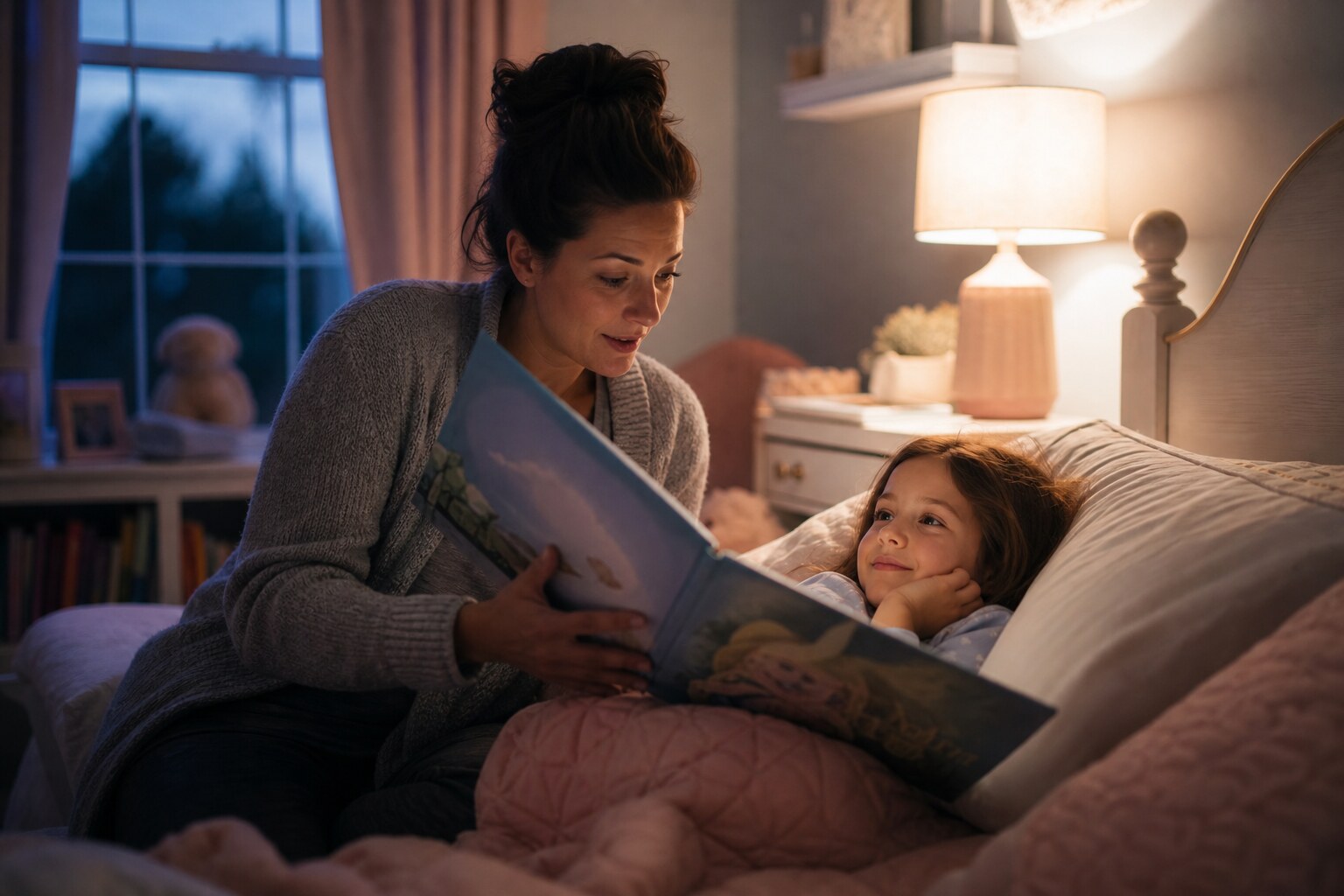
It's 8:30 p.m. The lights are dimmed, the day's chaos is finally settling, and your child is under the blankets, slowly winding down. You sit beside them, running on empty, ready to collapse yourself.
Then comes the whisper: "Can you tell me a story?"
Your mind goes completely blank. No story left in the tank. Nothing planned. You do not feel like a storyteller right now — you feel like a person who wants to lie down.
It's tempting, in that moment, to hand over a tablet and let a cartoon do the work. But the ten to fifteen minutes right before sleep turn out to be some of the most valuable of your child's entire day — and understanding why makes it much easier to get through them well, even when you've got nothing left.
Why kids ask for a story at bedtime
A request for a story at night is rarely a stalling tactic. Bedtime is a genuine emotional transition, and asking for a story is how a young child manages it.
They're seeking emotional security. Moving from a busy, loud day into a dark, silent room is a real adjustment for a small nervous system. "Tell me a story" often really means "stay close to me while I settle."
Your voice does something physical to their body. A parent's familiar, calm voice helps activate the vagus nerve — part of the body's built-in calming system — which in turn slows heart rate and shifts the body out of "alert" mode and into rest. This is the physiological groundwork behind why a warm, steady voice reads as safety to a child's body, not just their mind.
It gives their imagination somewhere quiet to go. A gentle, predictable story gives an active mind something calm to focus on, which crowds out the space that nighttime worries and fears would otherwise fill.
What the research actually shows
Vocabulary. A widely cited 2019 study published in the Journal of Developmental & Behavioral Pediatrics found that children read to once a day hear roughly 290,000 more words by kindergarten than children who are never read to. That gap is one of the strongest predictors of later reading fluency.
Stress reduction. Reading itself has a measurable calming effect on the body — a well-known piece of research out of the University of Sussex found that around six minutes of reading was enough to noticeably lower physiological stress markers like heart rate. It wasn't a study of bedtime stories specifically, but the underlying mechanism — a calm, focused activity slowing the body down — is exactly what a bedtime story does in practice.
Warmth and connection. Regular parent-child reading routines are consistently linked to stronger emotional security in early childhood, and that security is part of what builds empathy and resilience over time.
The problem with screens at bedtime
When you're out of story ideas, handing over an animated video feels like the easy fix. It creates two separate problems, and both work directly against sleep.
Melatonin shuts down
Young children are not just small adults where light is concerned. Preschool-aged eyes have significantly larger pupils and clearer lenses than adult eyes, so far more light reaches the retina — and the brain's sleep-hormone response is correspondingly more sensitive.
A University of Colorado Boulder study on preschoolers found that exposure to bright light in the evening suppressed melatonin production by an average of nearly 88%. In seven out of ten children studied, melatonin stayed below half its normal level for a full 50 minutes after the light was switched off. A young child's body doesn't shrug off a bright screen the way an adult's does — it takes real time to recover.
The brain gets activated instead of calmed
Researchers at Cincinnati Children's Hospital used brain imaging to compare how preschoolers' brains respond to the same story told three different ways: read aloud over a blank screen, read aloud with still illustrations, and shown as a fully animated cartoon.
The animated version produced the weakest connectivity between the brain's attention, language, and reflection networks — the animation did the visual work for the child, leaving less room for their own imagination to engage. The illustrated, read-aloud version struck what researchers described as a kind of "Goldilocks" balance: enough visual anchor to support the story, without doing all the imaginative work for them, leaving the brain calmer and more integrated than either the blank-screen audio or the full animation.
The takeaway isn't "no screens, ever." It's that fast-moving, self-narrating animation is the specific problem — not the presence of a screen itself.
Why your voice wins, even on a phone
There's a real difference between handing your child a tablet with an auto-playing cartoon and reading a story to them yourself off your phone. In the second case, the phone is acting as digital paper. You're still the storyteller.
Auto-narrated animated apps put the screen in charge — flashing animation, sound effects, and a stranger's voice doing all the narrating. This is the version that overstimulates the visual system and works against melatonin.
You, reading aloud — even from a phone keeps your voice as the center of the room while the screen stays secondary. This is the version that lets a child's own imagination do the work, and — with brightness turned down — has minimal impact on melatonin.
Audio stories with you sitting close go a step further: zero direct screen light at all, while your physical presence — sitting near them, a hand on their back — still provides the co-regulation their body is looking for.
Three rules for screen-based storytelling
Turn the screen away from your child. Hold the phone so only you can see the text. Let them lie back, close their eyes, and build the pictures in their own head.
Turn the brightness down. Dark mode, lowest setting. A harsh glow across a dark room works against everything you're trying to do.
Stay present. If you're playing an audio story, don't set the phone down and walk away. Sit close, hold their hand, let your body be part of the story too. The physical closeness is doing real physiological work, not just filling time.
What to do when you genuinely have nothing left
Keep a curated story ready to go. A platform with pre-selected, wind-down-paced stories — Sleepy Saga is built for exactly this — means you don't have to invent anything. Sit close, open a story, read.
Tell a real memory instead. A quiet story from your own childhood, or the story of the day they were born. Kids are endlessly drawn to real stories about their own family, and these require zero preparation.
Let an audio story carry the words while you carry the presence. Press play on a gentle audio story, dim the lights all the way, and lie down next to them. Your voice gets a rest. Your child still gets the full physiological benefit of you being right there.
The best ten minutes of their day
Your child won't remember, years from now, whether the story came from a hardcover book, a library paperback, or a phone screen held at arm's length. They'll remember the warmth of the blanket, the quiet of the room, and the sound of your voice walking them toward sleep.
So tonight, when they ask, don't worry about being a brilliant storyteller. Dim the lights. Pull up a story. Sit close. Let your voice do the one thing no screen ever really can.
Try this tonight. If your mind goes blank at bedtime, open Sleepy Saga, pick a short story, and just read it aloud — screen turned away, brightness down, voice steady. That's the whole formula.
Frequently asked questions about bedtime stories and screens
Is it bad to read a bedtime story from a phone or tablet?
Not inherently. What matters most is who's doing the storytelling. Reading text aloud from a phone, with the screen turned away from your child and the brightness lowered, has a very different effect than handing them an auto-playing animated video — your voice stays the focus, and the light exposure is minimal.
Why do animated cartoons make it harder for kids to fall asleep?
Two separate reasons. Bright screen light suppresses melatonin production, especially in young children whose eyes let in far more light than adult eyes do. Separately, brain-imaging research shows fast-moving animation reduces connectivity between the brain's attention, language, and reflection networks — the animation does the imaginative work instead of the child's brain doing it, leaving them more visually stimulated rather than calmer.
How much melatonin suppression does screen light actually cause in kids?
A University of Colorado Boulder study on preschoolers found that bright evening light suppressed melatonin by an average of nearly 88%, and in most children studied, melatonin remained suppressed for a full 50 minutes after the light source was removed. Preschoolers are meaningfully more light-sensitive than adults because of their larger pupils and clearer eye lenses.
What's the actual benefit of reading aloud to my child every night?
Beyond the emotional connection, research has found that children read to daily hear roughly 290,000 more words by kindergarten than children who are never read to — a gap strongly linked to later reading fluency. Reading aloud also supports emotional security and the calming, parasympathetic response triggered by a familiar caregiving voice.
What should I do if I don't have a story to tell?
Three easy options: use a curated bedtime story platform so nothing has to be invented on the spot, tell a real story from your own childhood or theirs, or press play on a gentle audio story while lying close beside them — the physical presence still delivers the calming benefit even if you're not the one talking.
Related reading
- "Everyone Else Has One! Don't You Trust Me?" — The Smartphone Question Every Parent Dreads — More on how screen design affects kids' brains, and what to offer instead.
- Your Toddler Isn't Being Bad. Their Brain Just Isn't Finished Yet. — Why a calm, connected bedtime is one of the best tantrum-prevention tools you have.
- Caught Your Kid Lying? Here's What's Actually Going On In Their Brain — Why the emotional safety built at bedtime shapes honesty during the day.
Sources & further reading
- Logan, J. A. R., et al. (2019). When Children Are Not Read to at Home: The Million Word Gap. Journal of Developmental & Behavioral Pediatrics.
- University of Sussex Mindlab (Lewis, D., 2009) — reading and physiological stress reduction. General reading research, not bedtime-story-specific.
- Akacem, L. D., Wright, K. P., & LeBourgeois, M. K. (2018). Sensitivity of the circadian system to evening bright light in preschool-age children. Physiological Reports.
- ScienceDaily — Preschoolers exposed to nighttime light lack melatonin.
- Hutton, J. S., et al. Differences in functional brain network connectivity during stories presented in audio, illustrated, and animated format in preschool-age children.
- BOLD — The effect of story format on children's brains.
- Porges, S. W. — Polyvagal Theory: the role of the vagus nerve in social engagement and calming response.
Want more articles like this, every week?
Research-backed parenting tips, straight to your inbox. No spam, unsubscribe anytime.