Panchatantra Stories for Kids: 5 Tales & What They Teach
Sleepysaga Team · October 21, 2026
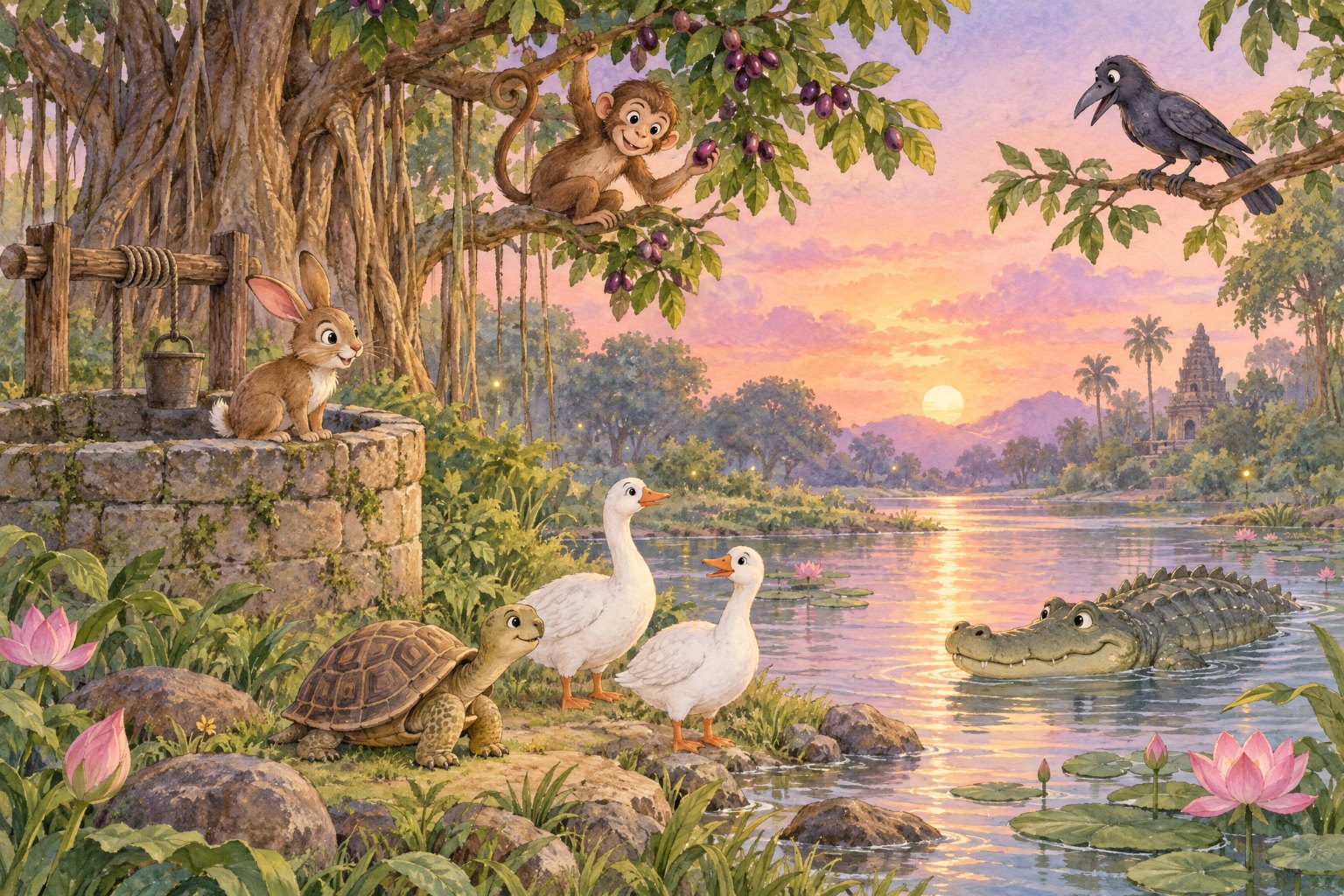
You've just finished the one about the clever rabbit and the lion. The rabbit tricked the cruel lion into jumping down a well, the forest is safe, and your six-year-old is grinning.
Then comes the question:
"So lying is okay if the other person is bad?"
You hesitate. That wasn't the lesson you thought you were teaching.
It's a better question than it sounds — and it gets to the heart of what makes the Panchatantra special. These stories weren't written to give children simple rules. They were written to make young minds think.
The short answer: the Panchatantra is an ancient collection of Indian animal fables, traditionally credited to a scholar named Vishnusharman, who told them to teach practical wisdom to three young princes. The best Panchatantra stories for kids — the Lion and the Hare, the Monkey and the Crocodile, the Tortoise and the Geese, the Four Friends, and the Brahmin's Wife and the Mongoose — work best not with a moral tacked on at the end, but with a question or two that gets your child talking.
Where the Panchatantra comes from
The story behind the stories is itself a story. In the book's own introduction, Amarashakti, king of Mahilaropya, despairs because his three sons are uninterested in learning. An elderly, learned Brahmin named Vishnusharman takes on the job of teaching them — through animal stories.[1][2]
There is no evidence that Vishnusharman was a real historical person; he belongs to the frame story. Scholars also disagree on when the Panchatantra was composed. The Sanskrit scholar Johannes Hertel placed it around 200 BCE, while translator Patrick Olivelle describes the current scholarly view as around 300 CE, calling it "only an educated guess."[1][2] Many of the individual fables are likely older still.
Pancha means five and tantra can mean a treatise or a set of principles. The Panchatantra has five books:[1][2]
- Mitra-bheda — the loss of friends
- Mitra-labha (or Mitra-samprapti) — the winning of friends
- Kakolukiyam — of crows and owls (war and peace)
- Labdha-pranasham — the loss of what you have gained
- Aparikshita-karakam — rash, ill-considered action
These stories have travelled further than almost any other book from India. In the 6th century CE, they were translated into Middle Persian; around 750 CE, they became the Arabic Kalila wa Dimna, and from there spread across the Middle East and into Europe, where they were known as the Fables of Bidpai.[1][2]
Why these stories aren't "moral stories" — and why that's a good thing
The Panchatantra is a book of niti — practical wisdom for getting along in a complicated world. Its heroes often win through cleverness, and sometimes through outright trickery. The rabbit lies to the lion. The monkey lies to the crocodile. That's not a flaw in the stories; it's the point. They teach children to think: Who can I trust? When should I speak, and when should I stay quiet? What happens if I act before I check?
Research also suggests that simply telling children "the moral" doesn't work very well. In a well-known experiment with 268 children aged 3 to 7, researchers tested whether classic stories made children more honest. "The Boy Who Cried Wolf" and "Pinocchio", which focus on the punishment for lying, didn't change children's behaviour. A story that showed honesty being praised did make children more likely to tell the truth.[3] As the lead researcher put it, emphasising the positive outcomes of good behaviour, rather than the negative consequences of bad behaviour, appears to be the key.
So with these five stories, the conversation afterwards matters more than the moral.
5 Panchatantra stories for kids — and the conversation each one opens
1. The Lion and the Hare (Book 1)
A cruel lion is eating the animals of the forest, so they agree to send him one animal a day. When it's a small hare's turn, he arrives late and tells the lion another lion stopped him on the way. The furious lion demands to see his rival — and the hare leads him to a deep well, where the lion sees his own reflection, leaps in, and drowns.
What it teaches: brains can beat brawn; being small doesn't mean being helpless.
Ask your child: "The hare told a lie. Was that okay? Why do you think so?" Then: "Can you think of a time when it would not be okay to trick someone?" There's no single right answer — the thinking is what matters.
Best for: ages 5 and up.
2. The Monkey and the Crocodile (Book 4)
A monkey living in a rose-apple tree becomes friends with a crocodile and shares fruit with him every day. The crocodile's wife decides she wants to eat the monkey's heart, and the crocodile tricks his friend into riding on his back across the river. Halfway across, he admits his plan. The monkey thinks fast: "Oh no — I left my heart in the tree! Take me back and I'll get it." Once back on land, he climbs to safety.
What it teaches: staying calm when you're frightened; not every friendly face is a true friend.
Ask your child: "How do you think the monkey felt when he heard the plan? What did he do instead of panicking?" Then: "How can you tell if someone is a real friend?"
Best for: ages 4 and up. There's danger, but no one is hurt.
3. The Tortoise and the Geese (Book 1)
When their lake begins to dry up, two geese offer to carry their friend the tortoise to a new lake. He bites onto the middle of a stick while they each hold an end — but they warn him: don't open your mouth. Flying over a town, the tortoise hears people laughing at the strange sight. He can't resist answering back, opens his mouth, and falls.
In the original Sanskrit, the fall is fatal — the townspeople eat him.[4] Most modern bedtime retellings soften the ending, and that's a sensible choice for young children.
What it teaches: sometimes the wisest thing is to stay quiet; listen when friends warn you.
Ask your child: "Why couldn't the tortoise keep his mouth shut? Have you ever really, really wanted to say something but known you shouldn't?"
Best for: ages 4 and up, with a softened ending.
4. The Four Friends (Book 2)
A crow, a mouse, a tortoise and a deer become the closest of friends. When the deer is caught in a hunter's net, the mouse gnaws through it. But the slow tortoise is captured instead. So the friends make a plan: the deer lies by the lake pretending to be dead, the crow pretends to peck at it, and when the hunter puts down the tortoise to grab the deer, the mouse chews through the tortoise's ropes. Everyone escapes.
What it teaches: friendship and teamwork — each friend has a different strength, and together they're stronger than the hunter.
Ask your child: "What was each friend good at? What are you good at that could help a friend?"
Best for: ages 4 and up. This is the gentlest of the five and an excellent bedtime choice.
5. The Brahmin's Wife and the Mongoose (Book 5)
A Brahmin's wife goes to fetch water and asks her husband to watch their baby, but he leaves too, and the family's pet mongoose stays with the child. A snake slithers towards the cradle, and the mongoose kills it. When the mother returns and sees the mongoose's bloody mouth, she assumes the worst and kills it with her water pot — only to find the baby safe and the dead snake beside the cradle.[5]
What it teaches: don't act in anger before you know the whole story.
Ask your child: "What did the mother think had happened? What could she have done before she got angry?" Then: "Has anyone ever been cross with you before they knew what really happened?"
Best for: ages 7 and up, and better told in the daytime. The ending is sad, and younger children may find it upsetting before sleep.
What to do
Ask questions instead of announcing the moral. One or two open questions — "Why do you think…?" or "What would you have done?" — let your child find the lesson themselves.
Praise the good choice, not just the punishment. Talk about how clever the hare was, how loyal the four friends were, how calm the monkey stayed.
Match the tale to the age. The Four Friends and the Monkey and the Crocodile work well from age four. Save the Mongoose for older children, and for daytime.
Tell one story a night. These are short stories. One story, one question, then lights out.
What not to do
Don't present every trick as a good thing. When the hero lies, talk about when cleverness is fair and when it isn't. That's exactly the kind of thinking the Panchatantra was written to build.
Don't tell the saddest stories at bedtime to young children. Save the Mongoose for when your child is older and it's daylight.
Don't worry if your child "gets the moral wrong". Young children often take away a different lesson than adults expect. The conversation is where the learning happens.
Don't assume every "Panchatantra" story online is from the Panchatantra. Many websites mix in stories from the Hitopadesha (a later reworking) or the Buddhist Jataka tales. The Blue Jackal, for example, isn't in Edgerton's reconstruction of the original text — it appears in later versions and in the Hitopadesha.[6]
Panchatantra-inspired stories on Sleepy Saga
- Panchvan Tales — our own jungle fables, inspired by the Panchatantra tradition. The Rabbit and the Roaring Well is our retelling of the Lion and the Hare, featuring clever little Chintu Rabbit and his wise grandmother. Other tales bring new forest friends and new lessons, from The Monkey Who Cried Tiger to The Firefly Who Couldn't Glow.
- Classic fables collection — includes The Tortoise and the Ducks, a gentle retelling of the same idea as the Tortoise and the Geese, where the chatty tortoise lands safely in a haystack.
- Akbar Birbal ki Kahaniya — for children who love the clever-thinking side of the Panchatantra, Birbal's puzzles are the perfect next step.
Panchvan Tales and Akbar Birbal are both available in Hindi — perfect for Panchatantra ki kahaniyan-style bedtime storytelling in your home language.
Try this tonight. Read one story, then ask just one question: "What would you have done?" Listen to the answer without correcting it. You'll learn as much about your child as they learn from the story.
Frequently asked questions
Who wrote the Panchatantra?
The Panchatantra is traditionally credited to Vishnusharman, a wise Brahmin who appears in its opening frame story, teaching three princes. There's no evidence he was a historical person, and the real author or authors are unknown.
What are the five books of the Panchatantra?
Mitra-bheda (the loss of friends), Mitra-labha (the winning of friends), Kakolukiyam (crows and owls), Labdha-pranasham (losing what you have gained), and Aparikshita-karakam (rash action).
When was the Panchatantra written?
Scholars don't agree. Estimates range from around 200 BCE to around 300 CE, and many of the individual stories are probably older.
Which Panchatantra story is best for bedtime?
The Four Friends (crow, mouse, tortoise and deer) is the gentlest — a story about friendship and teamwork where everyone ends up safe. The Monkey and the Crocodile is another good choice for children aged four and up.
Is the Blue Jackal a Panchatantra story?
It's often described that way, but it isn't in Franklin Edgerton's reconstruction of the original Panchatantra. It appears in later, expanded versions of the Panchatantra and in the Hitopadesha.
Related reading
- Best Krishna Stories for Kids (and What Each One Teaches) — more Indian stories with lessons that land.
- Hanuman Stories for Children: 7 Adventures and Their Lessons — courage and self-belief.
- Caught Your Kid Lying? Here's What's Actually Going On In Their Brain — for when the "is lying okay?" question gets real.
Sources & further reading
- Encyclopaedia Britannica. Panchatantra: Indian literature.
- Wikipedia. Panchatantra (citing Olivelle, P. (1997). The Pañcatantra: The Book of India's Folk Wisdom. Oxford University Press).
- Lee, K., Talwar, V., McCarthy, A., Ross, I., Evans, A., & Arruda, C. (2014). Can classic moral stories promote honesty in children? Psychological Science, 25(8), 1630–1636.
- Wikipedia. The Tortoise and the Birds (Panchatantra and Jataka versions).
- Wikipedia. The Brahmin and the Mongoose (citing Ryder, A. W. (1925). The Panchatantra, "The Loyal Mongoose").
- Wikipedia. List of Panchatantra stories (comparative table based on Edgerton's 1924 reconstruction).
Want more articles like this, every week?
Research-backed parenting tips, straight to your inbox. No spam, unsubscribe anytime.