How Long Should a Bedtime Story Be? A Guide by Age
Sleepysaga Team · October 21, 2026
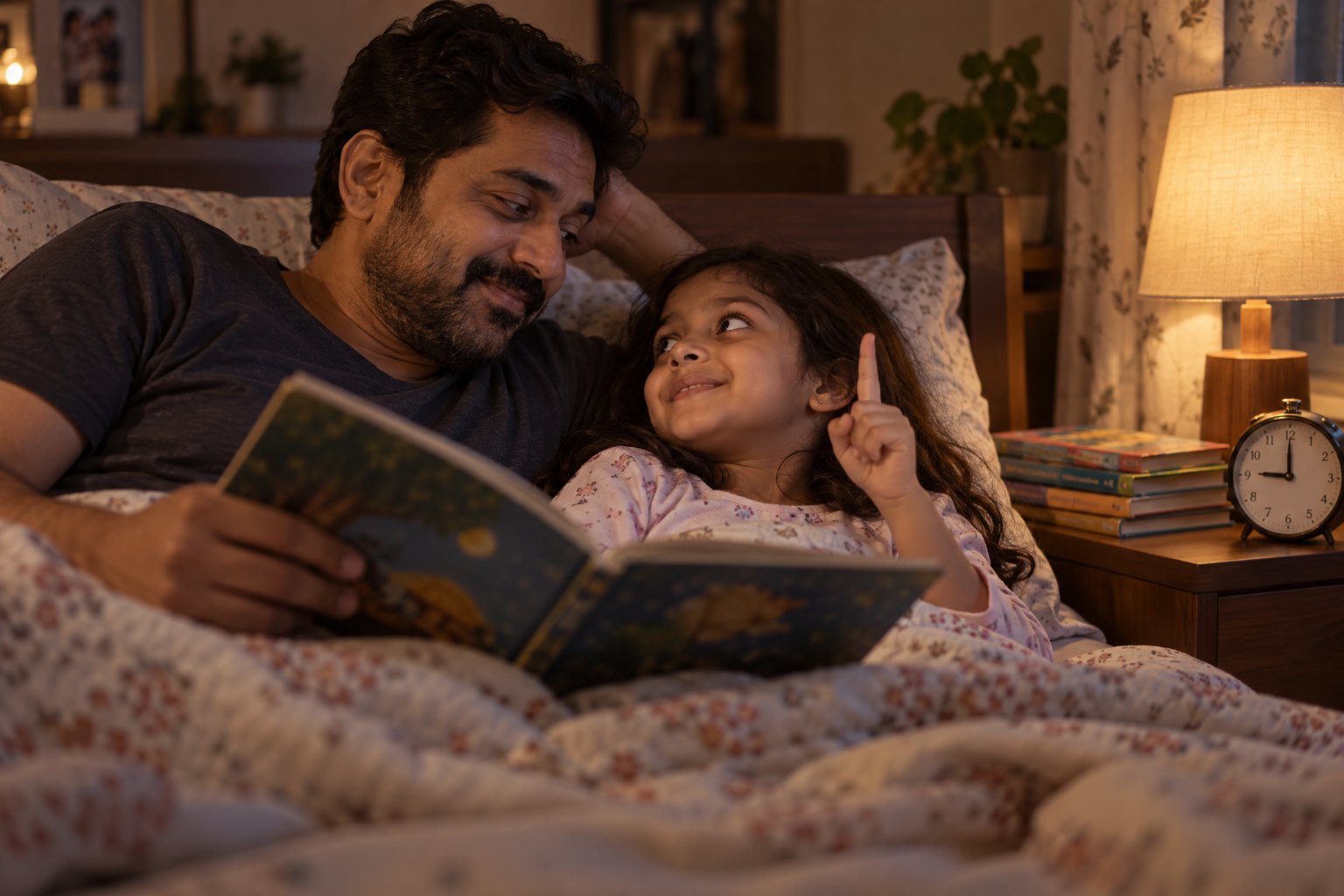
"One more. Please. Just one more."
You've already read three books. It's 10:40 p.m. Your six-year-old is somehow more awake than when you started, and you're wondering whether you're doing this wrong. Should the story be shorter? Longer? Is twenty minutes too much? Is five too little?
Then there's the other house, where the eight-year-old reads perfectly well on her own, and the parents have quietly stopped reading aloud altogether. That seems sensible. Does she still need it?
The short answer: no study has found one "correct" bedtime story length. A practical guide is 3–5 minutes for ages 2–3 (one or two short picture books), 5–10 minutes for ages 4–5, 10–15 minutes for ages 6–7, and 15–20 minutes — about one chapter — for ages 8–10. All of it should fit inside a calm, predictable bedtime routine. And no, you shouldn't stop reading aloud just because your child can read.
The honest truth: there's no magic number
You'll find confident numbers online. Most of them don't hold up.
The "2–3 minutes of attention for every year of age" rule is everywhere on parenting sites. We searched for its origin and couldn't trace it to any peer-reviewed study. Treat it as a rough rule of thumb at best. Attention depends heavily on the child, the time of night and the story itself — the same four-year-old who can't sit through a page of facts will happily listen to a favourite story twice.
The "1.4 million words" statistic is real, but it's rarely explained. It comes from a 2019 study by researchers at Ohio State University. They counted the words in popular children's books and calculated how many words a child would hear by age five at different reading frequencies.[1] The 1.4 million figure compares children read five books a day with children who are almost never read to. The more realistic comparison — one book a day versus none — works out to about 290,000 words by age five. That's still a big gap, and that's the number worth remembering. It measures words heard, not vocabulary learned, but it shows how quickly a short daily habit adds up.
That same study gives a useful benchmark: a typical picture book contains only about 200 words, and a board book even fewer.[1] For young children, a "full" bedtime story is much shorter than most parents think.
What research does tell us about length
Consistency beats duration. The strongest evidence isn't about minutes at all. A study of more than 10,000 children across 13 countries and regions — including nearly 1,000 children from India — found that a consistent bedtime routine was linked to falling asleep faster, waking less at night and sleeping longer. The more nights a week families kept the routine, the better children slept.[2] A short story every night does more than a long one now and then.
Sleep needs set the limit. Children aged 3–5 need 10–13 hours of sleep in 24 hours (including naps), and children aged 6–12 need 9–12 hours.[3] In India, preschool bedtimes are among the latest in the world — one multi-country study found an average of 10:26 p.m.[4] When bedtime is already late, the story should get shorter, not disappear.
Reading aloud still matters after age 7. In Scholastic's survey of American families, reading aloud peaks around age five. 58% of children aged 3–5 were read to five to seven days a week, falling to 45% at ages 6–8 and just 21% at ages 9–11. The most common reason parents gave for stopping was that their child could now read alone.[5] But children don't always want it to stop: in an earlier edition of the same survey, 40% of 6–11-year-olds said they wished their parents would keep reading aloud to them, because it was a special time together.[6]
Bedtime story length by age
These are practical guidelines, not research findings. Time your own favourite story once and adjust from there.
- Ages 2–3: a board or picture book, and rereads are welcome. About 100–250 words per book — 3–5 minutes (one or two books).
- Ages 4–5: a picture book or short story of about 200–500 words — 5–10 minutes.
- Ages 6–7: a longer picture book or a short chapter of about 400–700 words — 10–15 minutes.
- Ages 8–10: one chapter of a chapter book, about 700–1,500 words — 15–20 minutes.
What to do
Decide the amount before you start. "Two books tonight" or "one chapter tonight", said before you open the first book, ends most "one more" negotiations. Let your child choose which books; you choose how many.
Shrink, don't skip, on late nights. If it's 10:45 p.m., read one short story instead of none. Keeping the ritual matters more than its length.
Let chapters do the stretching. From around age six, a chapter book read a chapter a night gives children something to look forward to tomorrow, so one chapter feels like enough.
Keep the last few minutes slow. Lower your voice, slow your pace and dim the lights as the story ends. The end of the story is the start of sleep.
Keep reading aloud to good readers. Children can understand stories well above the level they can read themselves. Reading aloud lets an eight-year-old enjoy richer plots and vocabulary — and keeps the cuddle in the routine.
What not to do
Don't use a long story as a sleep strategy. Reading on and on until your child drops off often stretches bedtime rather than shortening it. End the story, then do your goodnight ritual.
Don't treat online "rules" as facts. If your four-year-old happily listens for twelve minutes, the attention-span formula is wrong for your child, not the other way round.
Don't stop reading aloud the day they can read. Swap roles instead: they read a page, you read a page. Or they read to themselves before lights-out and you read one chapter aloud.
Don't pick exciting stories to "fill the time". A longer story should also be a calmer one. Cliffhangers are fine for chapter books, but save chases and battles for daytime with younger children.
Sleepy Saga stories by length
Every Sleepy Saga story is broken into chapters, so you can match story time to the night you're having.
- Ages 3–5 — about 3–5 minutes: Pip the Listening Mouse and Adventures with Dr. Jojo. Each Dr. Jojo chapter is around 400 words — a complete, gentle story in one sitting.
- Ages 5–8 — about 5–8 minutes: Chi Chi Bird (about 370–450 words per chapter) and our collection of classic fables, most of which run 300–450 words per story.
- Ages 8–10 — one chapter a night: Dogsy and the Friends has 19 detective adventures, with chapters averaging around 1,000 words — a satisfying 10–15 minute read. Akbar Birbal ki Kahaniya (about 650–850 words each) is perfect for nights when you want a complete story with a clever ending.
Try this tonight. Before you open the book, tell your child how much you'll read — "one chapter" or "two short stories" — and stick to it. Then do the same tomorrow.
Frequently asked questions
How long should I read to my child at night?
For toddlers, 3–5 minutes (one or two short books) is plenty. For ages 4–5, aim for 5–10 minutes; for ages 6–7, 10–15 minutes; and for ages 8–10, one chapter of about 15–20 minutes. Doing it most nights matters more than the exact number of minutes.
How many books should I read at bedtime?
For ages 2–5, one to three short picture books is typical. Agree on the number before you start reading, and let your child choose which ones.
Should I still read aloud to my 8-year-old who can read?
Yes. Reading aloud lets children enjoy stories above their own reading level and keeps bedtime connected. In one large survey, 40% of 6–11-year-olds said they wished their parents would keep reading aloud to them.
Is a 20-minute bedtime story too long?
Not for a child aged 8–10 reading a chapter book, as long as the routine still ends in time for enough sleep. For a toddler, 20 minutes is usually more than they need — split it into a shorter story plus a cuddle or lullaby.
Related reading
- Bedtime Stories for 3-Year-Olds: What to Pick & Skip — what makes a good story for the youngest listeners.
- The 10 Minutes That Matter Most — Why Your Voice Beats Any Screen at Bedtime — why those few minutes matter so much.
- The Early Years Compass — 5 Research-Backed Ways to Raise a Happy, Resilient 3- to 6-Year-Old — building calm, confident preschoolers.
Sources & further reading
- Logan, J. A. R., Justice, L. M., Yumuş, M., & Chaparro-Moreno, L. J. (2019). When children are not read to at home: The million word gap. Journal of Developmental & Behavioral Pediatrics, 40(5), 383–386.
- Mindell, J. A., Li, A. M., Sadeh, A., Kwon, R., & Goh, D. Y. (2015). Bedtime routines for young children: A dose-dependent association with sleep outcomes. Sleep, 38(5), 717–722.
- Paruthi, S., et al. (2016). Recommended amount of sleep for pediatric populations. Journal of Clinical Sleep Medicine, 12(6), 785–786.
- Mindell, J. A., Sadeh, A., Kwon, R., & Goh, D. Y. (2013). Cross-cultural differences in the sleep of preschool children. Sleep Medicine, 14(12), 1283–1289.
- Scholastic (2019). Kids & Family Reading Report, 7th Edition: The Rise of Read-Aloud. (US survey by YouGov.)
- Children's Book Council (2015). National survey finds that 83% of kids ages 6–17 loved being read aloud to (Scholastic Kids & Family Reading Report, 5th Edition).
Want more articles like this, every week?
Research-backed parenting tips, straight to your inbox. No spam, unsubscribe anytime.