
Screen Time vs Bedtime Stories: What Research Says
Sleepysaga Team · October 21, 2026
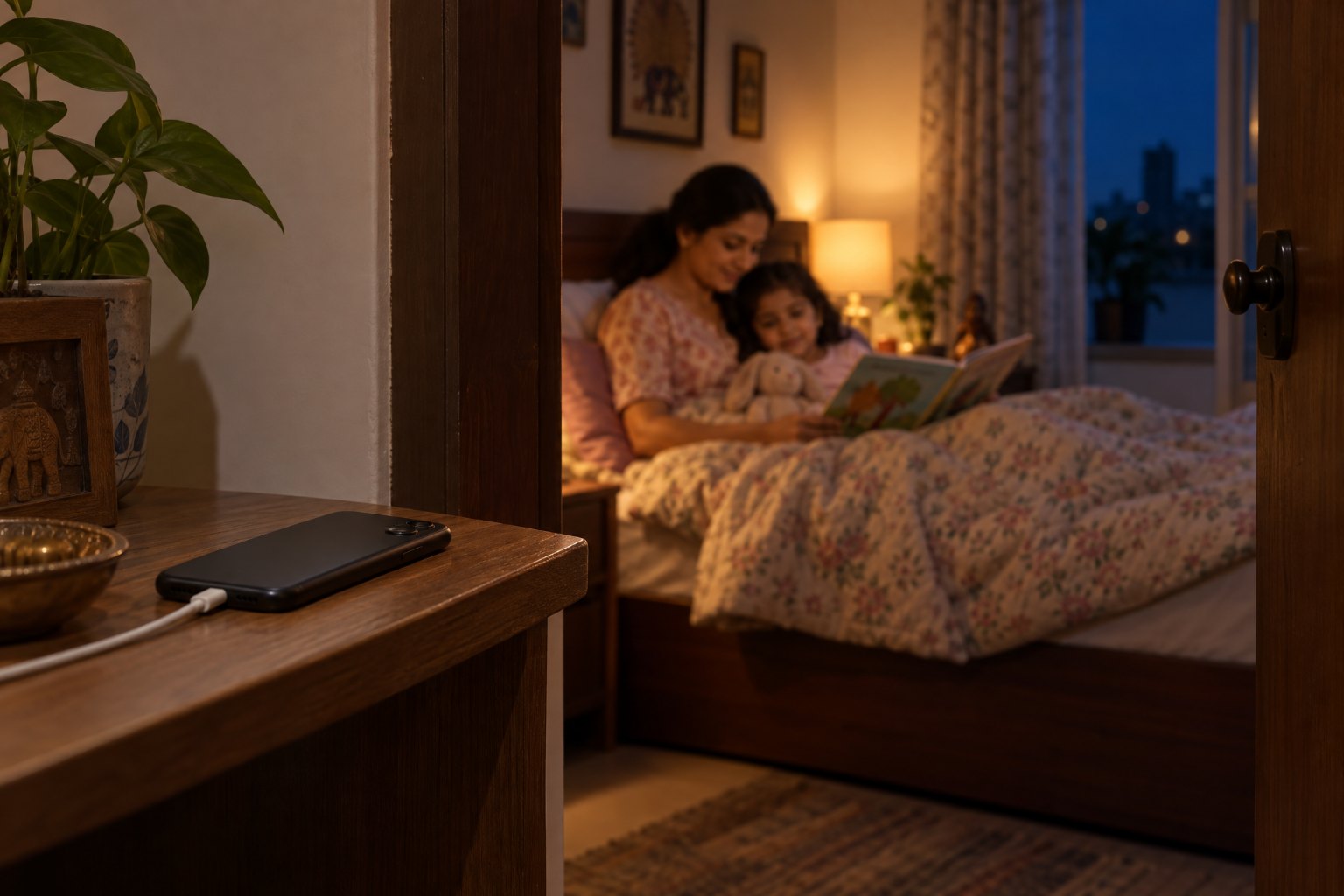
It's 9:45 p.m. "Five more minutes," your four-year-old pleads, eyes locked on the phone. You agree — it's been a long day, and the cartoon is keeping the peace. Five minutes becomes fifteen. When you finally take the phone away, there are tears, then bargaining, then a child who is somehow wide awake at 11:30.
The next night, you try a story instead. It takes effort. But by the third page, the room is quiet.
Most parents already sense that screens and sleep don't mix. What's less well known is why — and the answer changes what actually works.
The short answer: screen use before bed is consistently linked to shorter, poorer sleep in children, and the Indian Academy of Pediatrics (IAP) advises switching screens off at least one hour before bedtime. It's not only blue light: screens push bedtime later, excite the brain, and — for young children especially — any bright light suppresses the sleep hormone melatonin. A story read together in dim light does the opposite on all three counts.
What research says about screens and children's sleep
The evidence is large and consistent. A review of 67 studies found that screen time was linked to worse sleep — mainly shorter sleep and later bedtimes — in 90% of them.[1]
A meta-analysis in JAMA Pediatrics pooled data from 125,198 children (most of them teenagers). Using a device at bedtime was linked to roughly double the odds of not getting enough sleep. The surprising part: just having a device in the bedroom, even without using it, was also linked to shorter and poorer sleep.[2]
An honest caveat: most of these studies show a strong link, not proof of cause. But the link appears across ages, countries and study designs, which is why paediatric bodies take it seriously.
Three ways screens steal sleep
1. They push bedtime later. Screen time takes the place of winding down. "One more episode" is the easiest way for 9:30 to become 10:30.
2. They excite the brain. Fast-moving, exciting content keeps a child alert just when they need to wind down. The IAP's guidelines warn that violent content in particular can cause "excitement, fear or stress in children, leading to delayed onset of sleep."[3]
3. Light suppresses melatonin — and young children are extra sensitive. In a University of Colorado study, 36 children aged 3 to 5 were exposed to an hour of light before bed, at levels from very dim to very bright. Their melatonin fell by 70% to 99%. Even the dimmest light (5–40 lux — very dim indoor light) cut melatonin by an average of 78%, and there was little relationship between brightness and effect. In more than half of the children, melatonin still hadn't recovered 50 minutes after the light went off.[4]
The blue-light myth
"Just turn on night mode" is common advice. The evidence doesn't back it up.
In a study of 167 young adults, sleep was no better with iPhone's Night Shift turned on than with it off. Among those who slept about seven hours, people who didn't use their phone at all before bed slept better than either phone group.[5] The researchers concluded that blue light is only part of the story — what you're doing on the screen matters too.
That study was in adults, not children. But together with the preschool light research, the message for parents is clear: a blue-light filter is not a substitute for switching off.
What the IAP recommends, by age
The Indian Academy of Pediatrics published detailed screen-time guidelines for Indian families in 2022:[3]
- Under 2: no screens — only minimal, occasional screen time for social contact, such as with distant family.
- 2–5 years: a maximum of 1 hour a day, in sessions of no more than 20–30 minutes, always supervised — "the lesser, the better".
- 5–10 years: less than 2 hours a day, including educational screen time at home.
- All ages: screens off 1 hour before bedtime, with bedrooms and dining tables kept as digital-free zones.
The same guidelines show how far most homes are from this. Reviewing Indian studies, the IAP found a median age of first screen exposure of just 10 months, and that nearly 65% of families keep the TV on during dinner.[3] For children under five, the IAP specifically suggests storytelling, music and play as alternatives.
Why a story wins the last hour
A bedtime story works against every one of the three problems: it signals that the day is ending, it calms rather than excites, and it can be read in dim light.
It also brings you and your child closer. In a study published in Pediatrics, toddlers and parents talked more and worked together more when reading a print book than when reading the same story as an electronic book — especially one with sound effects and animation.[6] That back-and-forth conversation is exactly what builds language.
What about audio stories? There isn't strong research comparing them directly with video in children. But logically, an audio story removes both the screen light and the fast-moving pictures, while still giving a child a story to settle into — especially with you lying beside them.
A realistic 3-week swap plan
Going from "phone till bedtime" to "no screens for an hour" overnight usually ends in tears. The IAP notes that the most effective approaches set specific goals, involve parents heavily, restrict access to devices, and offer alternatives — and that change takes months, not days.[3] So do it in stages.
Week 1: move the cut-off to 30 minutes before bed. Start the screen-free time with something your child enjoys: bath, pyjamas, then a story. Charge every device outside the bedroom — including yours.
Week 2: move the cut-off to 45 minutes. Add a calm activity before the story — drawing, a puzzle, or just talking about the day.
Week 3: reach the full hour. Dim the house lights as screens go off. The story now sits at the heart of a screen-free hour.
Every week: give a warning, not a surprise. "Two more minutes, then it's story time" works much better than snatching the phone mid-episode.
What not to do
Don't rely on night mode or blue-light glasses. They don't fix the bigger problems: later bedtimes and an over-excited brain.
Don't let devices "sleep" in the bedroom. Even an unused phone or tablet in the room is linked to poorer sleep.
Don't replace a cartoon with a "story video". An animated story on a tablet is still a screen. If you read from your phone, use it like a book: turn the screen away from your child and set the brightness to the lowest level.
Don't make it a rule only for children. The IAP asks parents to be role models.[3] If you're scrolling in bed, your child notices.
Don't expect instant results. It can take a few weeks for a new routine to feel normal. Keep going.
Sleepy Saga stories for a screen-free last hour
Sleepy Saga was built for this hour: calm, short stories that you read aloud, so the phone stays in your hand and out of your child's eyes.
- Chi Chi Bird (ages 5–8) — in Chi Chi and the Wide-Awake Wobble, Chi Chi keeps fighting bedtime for "one more game" and learns the hard way why sleep matters. It's a gentle, funny way to talk about screen cut-offs without a lecture.
- Pip the Listening Mouse (ages 3–5) — a story built entirely around listening, perfect for the dimmest part of the evening.
- Smarty Sara (ages 8–11) — clever classroom mysteries for older children who are used to fast-paced shows, one short chapter a night.
A simple rule for reading from a phone: screen turned away from your child, brightness all the way down, and your voice doing the work.
Try this tonight. Thirty minutes before bed, plug the phones in outside the bedroom — all of them — and replace that time with a bath and one story. Then, next week, make it forty-five.
Frequently asked questions
How long before bed should kids stop using screens?
The Indian Academy of Pediatrics recommends switching screens off at least one hour before bedtime. If that feels too big a jump, start with 30 minutes and increase it over two to three weeks.
Is watching cartoons before bed bad for sleep?
It's linked to shorter and poorer sleep. Cartoons can push bedtime later, excite the brain, and the screen light suppresses melatonin — and preschoolers are especially sensitive to evening light.
Does night mode or a blue-light filter help children sleep?
There's little evidence that it does. In a study of young adults, Night Shift made no difference to sleep. Switching off the screen is what helps.
How much screen time is okay for a 4-year-old in India?
The IAP recommends a maximum of one hour a day for children aged 2–5, in sessions of no more than 20–30 minutes, always with an adult — and none in the hour before bed or during meals.
Are audio stories better than videos at bedtime?
Probably, though there's no strong direct research yet. Audio stories avoid screen light and fast-moving images. They work best with a parent close by, and with the device placed face-down or out of reach.
Related reading
- The 10 Minutes That Matter Most — Why Your Voice Beats Any Screen at Bedtime — what happens in a child's brain during a story versus a cartoon.
- "Everyone Else Has One! Don't You Trust Me?" — The Smartphone Question Every Parent Dreads — for parents of older children.
- Bedtime Reading Routine: A 20-Minute Step-by-Step Plan — what to do with the screen-free hour.
Sources & further reading
- Hale, L., & Guan, S. (2015). Screen time and sleep among school-aged children and adolescents: A systematic literature review. Sleep Medicine Reviews, 21, 50–58.
- Carter, B., Rees, P., Hale, L., Bhattacharjee, D., & Paradkar, M. S. (2016). Association between portable screen-based media device access or use and sleep outcomes: A systematic review and meta-analysis. JAMA Pediatrics, 170(12), 1202–1208.
- Gupta, P., Shah, D., et al. (2022). Indian Academy of Pediatrics Guidelines on Screen Time and Digital Wellness in Infants, Children and Adolescents. Indian Pediatrics, 59(3), 235–244.
- Hartstein, L. E., et al. (2022). High sensitivity of melatonin suppression response to evening light in preschool-aged children. Journal of Pineal Research, 72, e12780. Summary via ScienceDaily.
- Duraccio, K. M., et al. (2021). Does iPhone night shift mitigate negative effects of smartphone use on sleep outcomes in emerging adults? Sleep Health.
- Munzer, T. G., Miller, A. L., Weeks, H. M., Kaciroti, N., & Radesky, J. (2019). Differences in parent-toddler interactions with electronic versus print books. Pediatrics, 143(4), e20182012.
Want more articles like this, every week?
Research-backed parenting tips, straight to your inbox. No spam, unsubscribe anytime.