
Is My Child the Bad Influence? What to Do When It's Your Kid, Not Their Friend
Sleepysaga Team · August 23, 2026
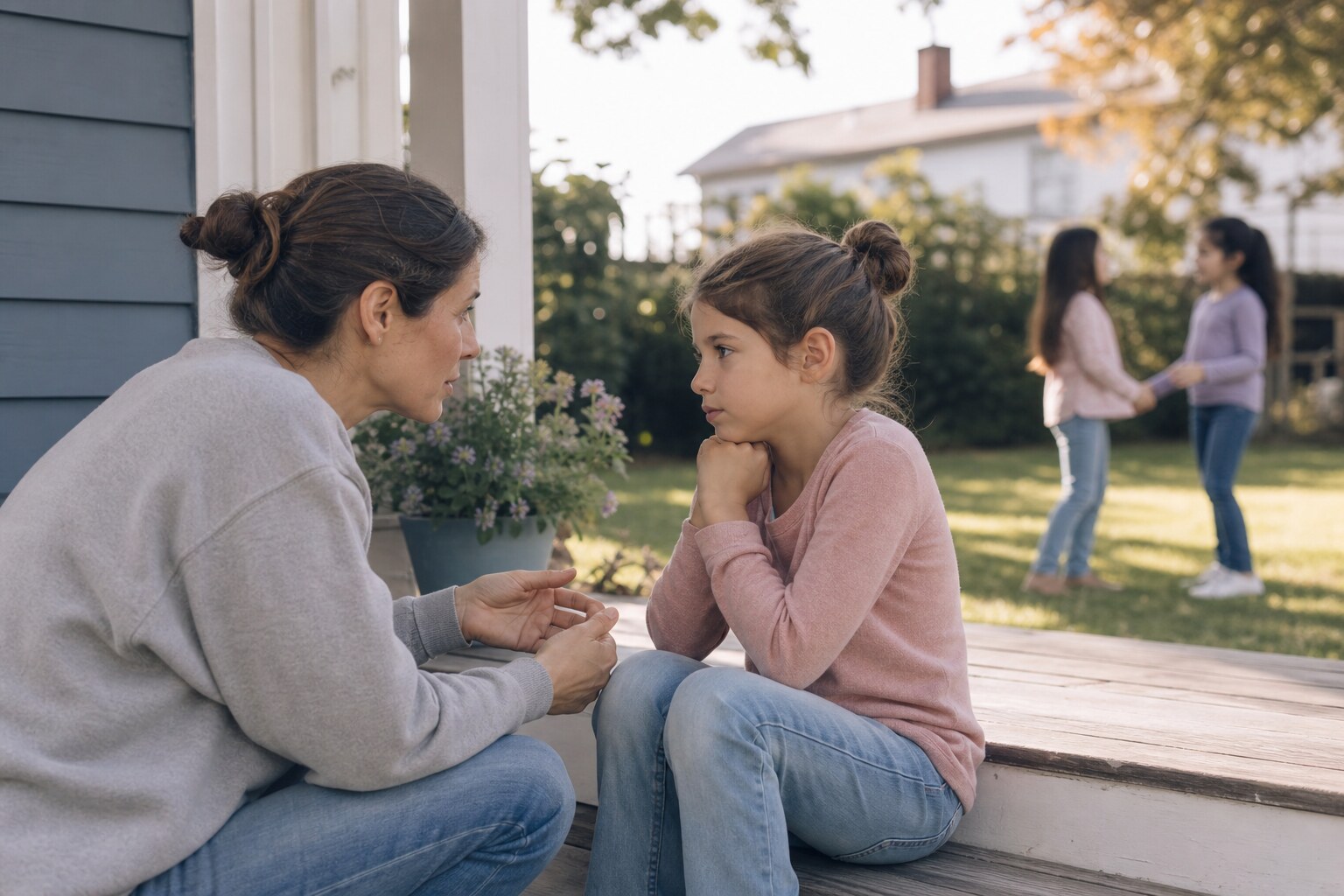
Every parent has felt the specific relief of deciding a friendship is the problem. If we can just get some distance from that kid, things will settle down. It's a much harder moment when a teacher, another parent, or your own gut starts pointing the other way — toward your child.
It's an uncomfortable question to sit with. But research on how children's social groups actually work suggests it's worth asking honestly, because the "bad influence" is not always the other kid.
The uncomfortable research: popular kids often lead the trouble
For decades, the assumption was that low-status, struggling kids were the ones dragging others into misbehavior. The actual research tells a more complicated story.
Children who are well-liked and socially central genuinely do shape what their friends do — including things parents wouldn't choose. Studies tracking real friendship networks over time find that higher-status children influence the behavior of lower-status friends toward things like rule-breaking and alcohol use, but the reverse effect is much weaker.[1] [2] Popular children are, in a very literal sense, leaders whose choices other kids watch and copy.
There's also a well-documented group of kids researchers call "bi-strategic" or popular-antisocial — children who are genuinely well-liked and use aggression, rule-breaking, or bossiness to hold onto that popularity. It isn't a contradiction to researchers: being the fun, magnetic kid other children want to be around, and being the one who starts the trouble, are often the same child.[3]
None of this means your child is a bad kid. It means social leadership is a real trait, and like most traits, it can point toward mischief just as easily as toward kindness — often in the very same child, in the same week.
How to tell if it's actually your child
A few patterns are worth paying attention to, not as accusations but as honest questions:
Do the same "incidents" follow your child into different friend groups? If your child gets blamed for starting trouble with more than one set of friends, across more than one setting, that's a pattern worth taking seriously — it's less likely to be one difficult friendship and more likely to involve your child's own choices.
Do other parents seem cautious around your child specifically? This one stings, but it's informative. A shift in how other families talk about playdates or invitations is often the clearest outside signal available.
Does your child seem to be the one proposing the risky idea, not just going along with it? There's a real difference between a child who gets talked into something and a child who's usually the one doing the talking.
Why criticism backfires here too
You've probably heard advice that banning a "bad influence" friend usually backfires — it drives the friendship underground and damages your relationship with your child. Less discussed: the same backfire effect shows up when parents respond to their own child's misbehavior with blanket criticism or shame.
Research on parental disapproval finds that when parents openly criticize a child's behavior or friendships, it can actively worsen the behavior and damage the child's standing with peers, rather than correcting anything.[5] A child who feels labeled — "the troublemaker," "the bad influence" — often lives up to the label, because it becomes easier to accept the identity than to fight it.
The goal isn't to make your child feel like a bad kid. It's to help a child with real social pull learn to use it well.
What to do instead
Get specific instead of global. "You've been mean lately" invites defensiveness. "I noticed you told Maya she couldn't sit with you at lunch — what was going on there?" invites an actual conversation. Naming the specific moment, not the character, is what makes this workable.
Ask questions before you conclude. Understanding what's underneath the behavior — wanting attention, testing limits, insecurity about their own social standing — matters more than the behavior itself. A child instigating trouble to feel powerful needs something different from a child doing it because it gets a laugh.[6]
Ask your child to think about impact, not just rules. "What do you think it felt like for him when the other kids followed you and left him out?" builds the kind of perspective-taking that actually changes behavior, more reliably than a flat consequence does.
Redirect the leadership, don't try to extinguish it. A child who can get a whole group to do something is a child with a genuinely valuable skill. The move is toward organizing the game everyone plays, not away from being a kid other children listen to.
Frequently asked questions about being the bad influence
How do I know if my child is really the instigator, and not just getting blamed?
Look for patterns across more than one friendship or setting, and pay attention to how other parents behave around your child specifically. A single incident with one friend usually isn't proof of anything. Repeated incidents across different friend groups are a stronger signal.
Can a popular child really be a bad influence?
Yes — research following real friendship networks shows that higher-status, well-liked children measurably influence their friends' behavior more than the reverse, and a specific "popular-antisocial" pattern is well documented, where kids stay popular partly by being bossy or rule-breaking. Popularity and being a bad influence aren't opposites.
Will telling my child they're "the bad influence" help them change?
Usually not. Labeling a child tends to make the behavior worse, not better, because the label becomes easier to live up to than to fight. Naming the specific behavior in the specific moment works better than naming the child's character.
What's the difference between confident and controlling in a child?
Confidence shows up as a child who can propose ideas and include others. Controlling behavior shows up as a child whose ideas only work if someone else is left out or overruled. The distinction is usually visible in whether other kids look happy or uneasy following along.
Should I limit my child's friendships if they're the instigator?
Rarely helps on its own, and can carry the same backfire risk as banning a friend who's a bad influence on your child — it can damage trust without addressing the underlying behavior. Addressing the specific behavior directly, with your child, tends to work better than managing it through their friend list.
Related reading
- When Your Child Befriends the "Bad Influence" — The other half of this question: what to do when it's their friend, not your child.
- The Comparison Trap — Why Comparing Your Child to Others Kills Their Confidence — More on why labeling a child's character backfires compared to naming specific behavior.
Sources & further reading
Peer influence and social status
- Relative likeability and relative popularity as sources of influence in children's friendships — PLOS ONE
- Individual Popularity, Peer Group Popularity Composition and Adolescents' Alcohol Consumption — PMC
- Adolescents' Popularity-Motivated Aggression and Prosocial Behaviors — Frontiers in Psychology
Group dynamics
Why labeling backfires
Practical guidance
Want more articles like this, every week?
Research-backed parenting tips, straight to your inbox. No spam, unsubscribe anytime.