
The Comparison Trap — Why Comparing Your Child to Others Kills Their Confidence
Sleepysaga Team · July 30, 2026
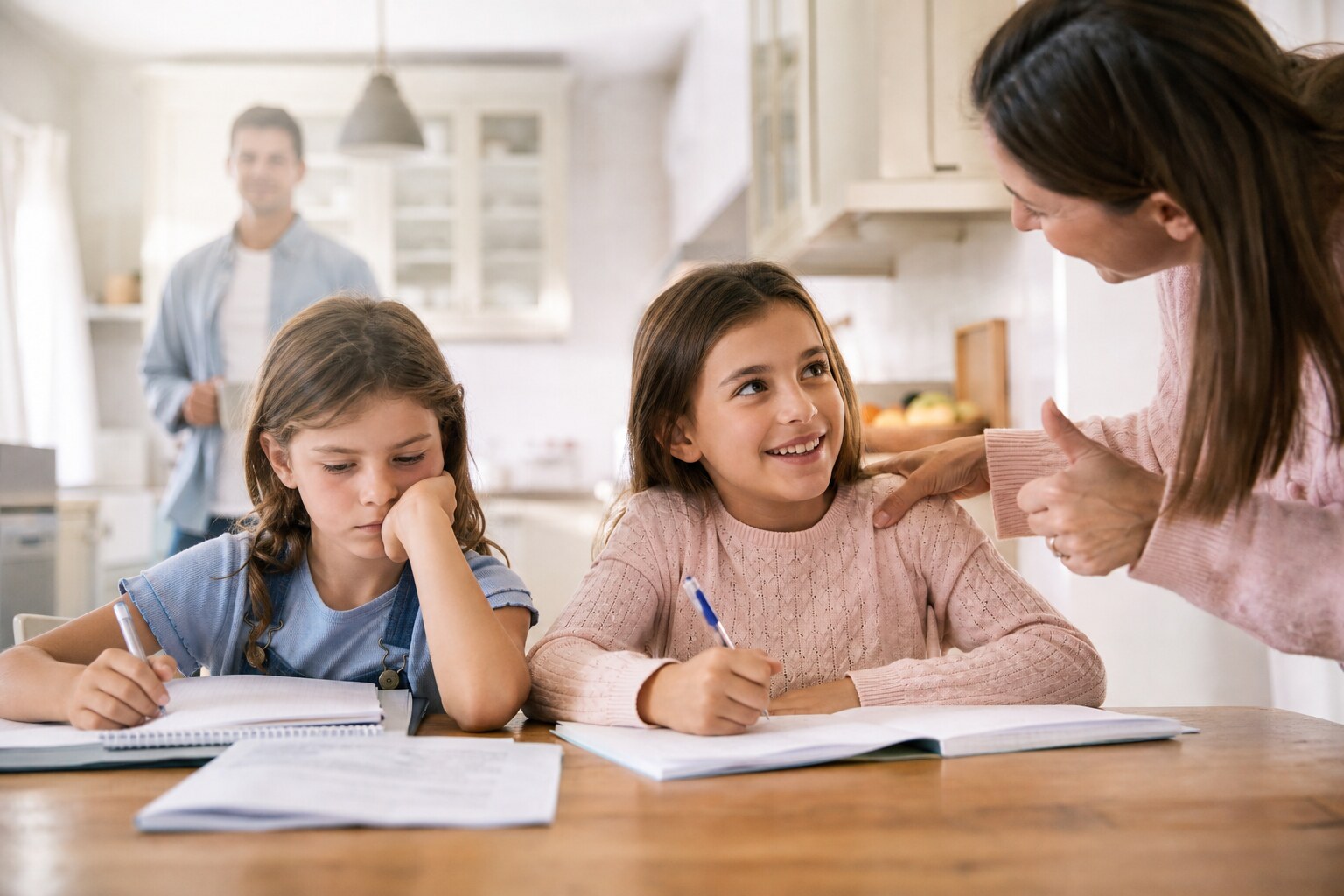
Have you ever met an adult who constantly craves reassurance — needing endless approval just to feel okay about themselves?
Or someone who secretly winces when a friend or colleague succeeds — finding it almost impossible to be genuinely happy for someone else's good news?
Or an adult who suffers from chronic low confidence, constantly scanning the room to see how they stack up against everyone else?
Psychology reveals a compelling connection. These adult struggles rarely start in adulthood. They are usually the long-term ripples of growing up in a home where love felt conditional — where a child's value was quietly measured against a sibling, a neighbor, or a classmate.[1] [2] [3]
The lesson that lodges in a developing mind is precise and devastating: "I am only good if I am better than someone else."
Why parents compare their children (and what we think we're doing)
No parent sets out to damage their child's confidence.
Picture a typical afternoon at home. Your nine-year-old runs through the door, waving a certificate from a school writing contest. You hug them and say: "I'm so happy you were able to beat Ethan! He's older than you, and you still won!"
Later that evening, over homework at the kitchen table, you turn to your younger child and sigh: "I'm sorry, but your brother is so slow compared to you. Why can't you finish your work quickly like he does?"
Sound familiar?
We make comments like these every day. We don't do it to be cruel. We do it because we love our kids and want them to reach their full potential. When we point to a peer doing better, we think we're setting a realistic bar. When we praise our kid for outperforming someone else, we think we're boosting their ego. When we compare siblings, we think we're setting clear standards.
To us, these phrases sound like motivation or high praise.
But developmental psychology shows a sharp disconnect between parental intent and child impact.[6] To a child's brain, comparative statements signal that parental warmth and acceptance are rewards that must be earned through competition.
That is what a developing mind hears. Not motivation. Conditional love.
The two kinds of comparison — and why both hurt child self-esteem
Psychologists distinguish between two forms of parental comparison. Understanding the difference is what makes the fix possible.
Upward comparison — "Why can't you be like them?"
You point to a peer or sibling who's performing better. In large surveys of children, phrases like "Look at other people's children" consistently rank as the single most disliked sentence kids hear at home.[2]
When your child hears this repeatedly, they don't feel motivated. They experience what psychologists call a contrast effect [3] — measuring their own private self-doubt against another child's polished external achievement. The result is chronic inadequacy, resentment, and learned helplessness.[5] "Why even try? I'll never be as good as them."
Downward or reverse comparison — "You beat Ethan!"
Here's the one that surprises parents. Praising your child by putting another child down is just as damaging.
When you say "I'm so happy you beat Ethan" or "Your brother is so slow compared to you," you are teaching your child that their worth isn't intrinsic. You are teaching them that their value depends on someone else's failure.[4]
In his book Unconditional Parenting [9], the parenting author Alfie Kohn writes that praise tied to outperforming others creates a deeply fragile ego.[7] [8] And this — precisely this — is why so many adults:
- Cannot handle other people's success. If childhood self-worth was built on being "better than Ethan," another person's success later in life feels like an existential threat to their own value.
- Constantly need external validation. Because self-worth was grounded in rank rather than intrinsic security, adults raised this way require continuous outside approval just to feel adequate.
The moment your child inevitably meets someone faster, smarter, or more talented, the ego that was built on being "better than Ethan" crumbles. Because it was never built on being confident in who they are.
What kids actually hear (and how it shows up in adulthood)
Comparative feedback, said day after day, becomes the child's inner voice for life. Here is the translation between what parents say, what kids interpret, and what shows up in adulthood.
"Look at how quickly your classmate finished their work." What they hear: My parents are disappointed in me. I am inherently flawed. Later in life: Chronic anxiety and low confidence. Persistent self-doubt and an ongoing need for external reassurance just to feel worthy.
"I'm so proud you beat Ethan in the contest!" What they hear: My parents only love me when I rank first. Winning is the only way to earn affection. Later in life: Perfectionism and imposter syndrome. Intense fear of trying anything where failure or being "average" is possible.
"Your brother is so slow compared to you." What they hear: Love is a competition in this house. Other people's weaknesses make me valuable. Later in life: Inability to celebrate others. Secret envy, resentment, and difficulty being genuinely happy for friends or colleagues.
"Why can't you be quiet and focused like your sister?" What they hear: Mom and Dad love my sister more because she's better than me. Later in life: Sibling distance. People-pleasing. Reshaping the self to match what others expect.
These comparisons don't feel like big moments to us. That's exactly why they land so hard on them.
What to do instead — 4 practical shifts
Fixing this isn't about withholding praise or lowering the bar. It's about changing the frame of your praise so it builds something unshakeable.[10]
1. Praise the effort and strategy, not the rank or outcome
In a famous study by Stanford psychologist Carol Dweck involving over 400 children [14], researchers tested two kinds of praise. One group was praised for intelligence and outcomes ("You got a great score, you must be so smart!"). The other was praised for effort ("You worked really hard on these problems").
The result was striking. Sixty-six percent of the outcome-praised kids later refused harder challenges — they were terrified of losing their "smart" label. Ninety percent of the effort-praised kids actively chose harder challenges, because they'd learned that growth comes from trying.
Instead of: "You wrote better than Ethan!" Try: "I saw how much effort you put into developing that story line. You worked hard on your ideas, and it really showed."
2. Compare your child only to their past self
If you want to use comparison constructively, compare your child to the only benchmark that actually matters: who they were yesterday.
Instead of: "Your brother is so much faster at math than you." Try: "Remember two months ago when these problems took ages? Look how much smoother you work through them now."
This tiny shift teaches personal agency — the belief that dedication leads to real growth, independent of anyone else's journey.
3. Separate your child's worth from their performance
Make sure your child knows that your warmth and affection are not tied to their scorecard, rank, or trophies.
In The Power of Showing Up [12] [13], Dr. Daniel Siegel writes that children thrive when parents consistently offer the 4 S's of secure attachment [11]: helping them feel safe, seen, soothed, and secure.
When children feel seen for who they are — rather than how they perform compared to others — their nervous system relaxes out of threat response and into deep, creative learning.
4. Build daily zero-pressure connection with a bedtime story
Children need regular moments in the day when performance metrics disappear entirely.
The most effective one is a fifteen-minute screen-free bedtime routine. Sitting close, reading a story aloud, no evaluation of any kind.
It delivers a message that no amount of daytime praise can: "At the end of the day, there are no tests, no ranks, and no comparisons. You are safe here."
If you're out of bedtime story ideas, Sleepy Saga has short, calming stories designed for exactly this purpose — the quiet close of the day where connection replaces evaluation.
The gift of unconditional love
Every parent wants to raise a child who grows into a confident, secure adult. An adult who doesn't constantly seek external assurance. Who doesn't feel threatened when a friend succeeds. Who is comfortable in their own skin.
That kind of adult confidence isn't built by convincing a child they are superior to Ethan. And it isn't built by nagging them to keep up with their peers.
Real confidence is born from the quiet, unshakeable knowledge that they are loved unconditionally [10] — just for who they are, not for where they rank.
Tonight, when you tuck your child in, take a moment to just look at them. Set aside the report cards, the competition results, the comparisons. Whispering a simple non-comparative phrase can heal a surprising amount of daily pressure:
"I love watching you grow. I love you just the way you are."
When children feel completely safe in your love, they stop needing to compete with the world. They are finally free to become the best version of themselves.
Try this tonight. Pick one comparative phrase you catch yourself using ("your sister is faster," "look how well X does…"). For one week, replace it with a comparison to your child's past self. Watch what shifts. Then, at bedtime, share a story from Sleepy Saga — no performance, no evaluation, just you and them, ending the day on connection.
Frequently asked questions about comparing children
Is it ever okay to compare children?
Comparing your child to another child is almost never helpful — even when the comparison is meant as praise. Both upward comparison ("why can't you be more like your sister?") and downward comparison ("you beat Ethan!") teach a child that their worth is conditional on outperforming someone else. The one form of comparison that does work is comparing your child to their own past self — this builds personal agency and a growth mindset rather than fragile self-worth.
Why does comparing my child to their sibling damage self-esteem?
Sibling comparison sends the message that love in your family is a competition, and the child who loses the comparison feels less valuable in your eyes. Peer-reviewed research on parental social comparison has linked this pattern to lower self-esteem, weaker parent-child closeness, and long-term difficulties like anxiety, imposter syndrome, and difficulty celebrating others' success in adulthood.
How does praising my child for beating another child cause harm?
This is called downward comparison or reverse comparison. It feels like a compliment, but the child hears: "I am only valuable when someone else loses." Alfie Kohn describes this as creating a "fragile ego" — self-worth that collapses the moment the child meets someone faster or more talented. It's one of the root causes of adult perfectionism and imposter syndrome.
What should I say instead of comparing my child to their siblings?
Praise the effort or strategy, not the rank. Instead of "you finished before your sister," try "I noticed how carefully you checked your answers." When you want to celebrate growth, compare your child to who they were a few months ago rather than to anyone else. Focus on the process, not the podium.
How do I raise a confident child?
Research on secure attachment and growth mindset points to four things: (1) praise effort, not innate traits; (2) let them know your love isn't tied to performance; (3) offer what Dr. Daniel Siegel calls the 4 S's — help them feel safe, seen, soothed, and secure; and (4) create daily zero-pressure connection routines, like a screen-free bedtime story, where evaluation disappears entirely.
How does bedtime connection reduce comparison damage?
A calm bedtime routine gives your child a daily fifteen-minute space where nobody is being ranked or measured. Physical closeness, a shared story, and unhurried attention send a nonverbal message that their worth doesn't depend on today's performance. Over time, this consistent evidence of unconditional presence is one of the most powerful antidotes to the comparison damage they encounter in school and social life.
What is unconditional parenting?
Coined by author and educator Alfie Kohn, unconditional parenting is the practice of loving and accepting your child regardless of their behavior, achievements, or rank compared to peers. It contrasts with conditional love, where affection is (often unconsciously) doled out as a reward for good outcomes. Kids raised with unconditional parenting show stronger self-esteem, lower anxiety, and healthier adult relationships.
Related reading
- Your Toddler Isn't Being Bad. Their Brain Just Isn't Finished Yet. — Why tantrums aren't misbehavior, and the four-step co-regulation playbook that actually works.
Sources & further reading
Parental social comparison and self-esteem
- Parental social comparison and adolescent self-esteem — PubMed
- "Other people's children" comparisons and youth self-esteem — PMC
- Upward social comparison and optimism — ResearchGate
- Social comparison and parent-child closeness — MDPI
- Social comparison shaming and basic psychological needs — PMC
- Parenting styles, warmth vs. rejection, and self-esteem — PMC
Unconditional parenting — Alfie Kohn
- Criticizing common criticisms of praise — Psychology Today
- Alfie Kohn on praise as conditional care
- Unconditional Parenting interview — Tilt Parenting
- Loving kids unconditionally — One Time Through
Secure attachment — Dr. Daniel Siegel
- The 4 S's of Secure Attachment — Eden Therapy
- The Power of Showing Up — Sunshine Parenting
- The Power of Showing Up (book summary) — Goodreads
Growth mindset — Dr. Carol Dweck
Want more articles like this, every week?
Research-backed parenting tips, straight to your inbox. No spam, unsubscribe anytime.