
When Your Child's “Friends” Are on a Screen — Roblox, Minecraft, and YouTube Peer Pressure
Sleepysaga Team · August 27, 2026
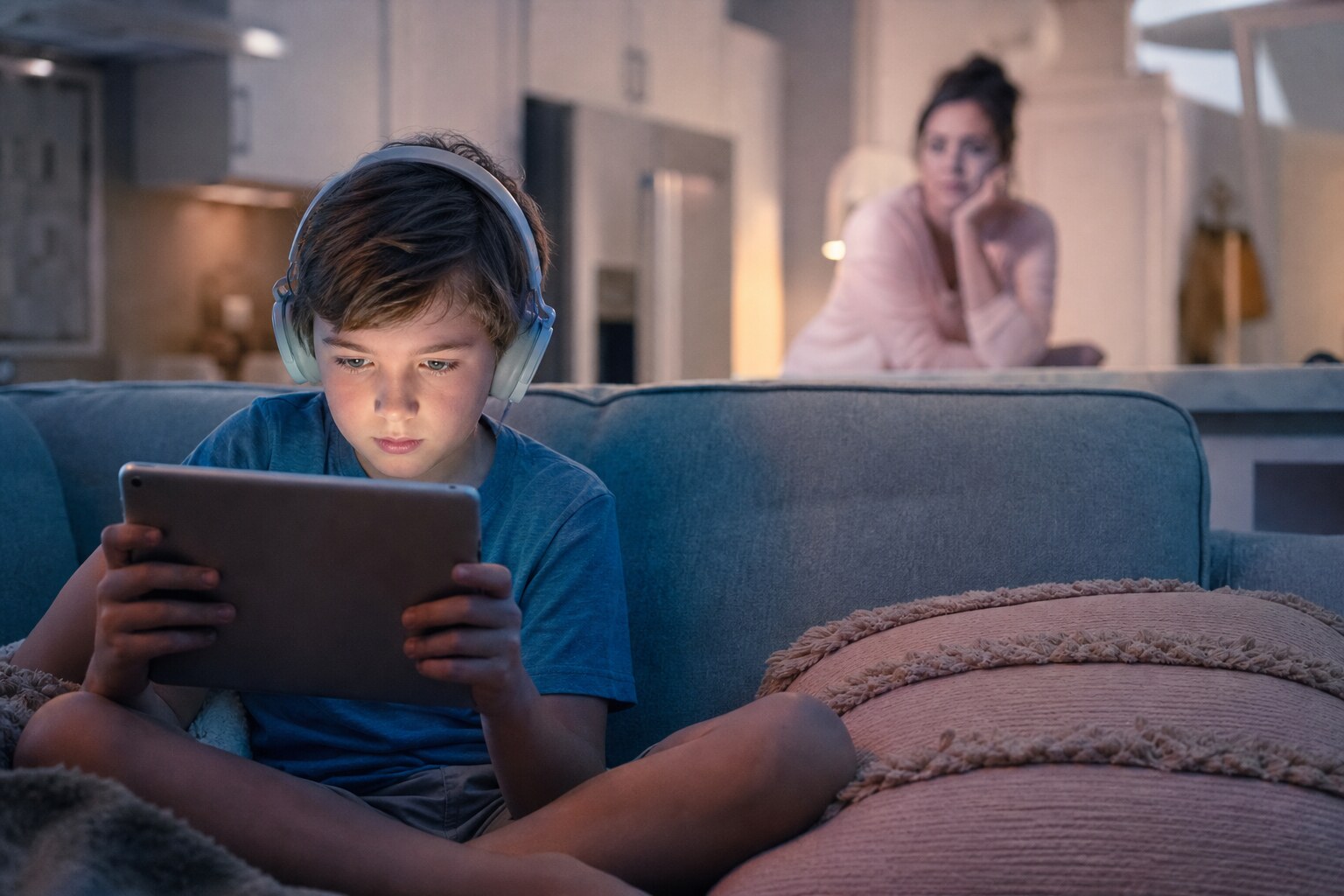
The playground "bad influence" used to have a name, a face, and parents you could talk to. Now it might be a username in a Roblox chat, a voice on the other end of a Minecraft server, or a YouTuber your child has watched enough times to start copying without ever having met.
For kids under 10, this is quickly becoming just as real a version of peer pressure as anything happening at recess — and it works differently enough that the usual playbook needs an update.
Younger kids are already deep in online friend groups
This isn't a distant, teenager-only concern anymore. The vast majority of kids ages 6 to 12 are actively watching YouTube, most of them daily, and Roblox in particular is built to be social from the moment a child logs in — chatting and "friending" other players is core to how the game works, not an optional extra.[1] Minecraft leans more toward solo or small-group play, but even there, a 2024 survey found most kids who play do so specifically with friends.[2]
Common Sense Media's actual age guidance reflects how social — and how unfiltered — these spaces can get: they recommend Roblox for age 13 and up, and specifically advise limiting chat for younger players.[1] A child well under that age is often chatting with strangers your family has never met, in language nobody previewed first.
Why online influence spreads differently than in-person influence
A friend down the street models one set of behaviors, in front of you, in your own home some of the time. An online "friend" — whether it's a Roblox chat partner or a favorite YouTuber — can model behavior constantly, with zero adult presence, and often with a kind of intimacy that feels bigger than the relationship actually is.
Researchers call this a parasocial relationship: a one-sided bond where a child feels close to a creator who has no idea the child exists.[6] Children form these attachments easily, and the more a creator feels "authentic" and likeable, the more a child's brain treats them like a real friend worth imitating[7] — which means the same imitation instinct that copies a friend's whine at school can just as easily copy a YouTuber's rudeness, slang, or attitude, without your child ever having met them.
The American Academy of Pediatrics' most recent policy guidance treats this as a structural feature of how kids now grow up, not a fringe issue — today's "digital ecosystem" shapes children's social development alongside, not separately from, their real-world friendships.[4]
The platforms are catching up, slowly
It's worth knowing the ground is actually shifting here, because it changes what's realistic to expect from the platforms themselves versus what's still on you.
Roblox has been rolling out mandatory facial age estimation for anyone who wants to use chat features, sorting users into age bands and restricting who can message whom — a global requirement as of January 2026.[3] That's a real improvement, but it estimates an age band, not who's a good influence — a same-age stranger can still model plenty you wouldn't choose for your child.
What actually helps
Treat online chat like you'd treat an unsupervised playdate, because that's what it is. Turning on a platform's chat restrictions for younger players isn't overprotective — it's the same instinct as knowing who's at the birthday party, applied to a space where you genuinely can't see who's talking.
Watch for behavior that shows up right after screen time, not just after playdates. A new phrase, a new tone, a new "everyone does this" — ask where it came from the same way you would after a playdate. "That's new — did you hear that from a game, or a video?"
Ask who your child's online friends actually are. Not to interrogate, but because most kids can tell you — a Roblox friend from a specific game, a YouTuber they watch daily. Knowing the actual names and channels turns a vague worry into something you can look at together.
Talk about parasocial closeness directly, in plain language. "You know a lot about her, but she doesn't know you exist — that's a bit of a one-way friendship." This isn't meant to diminish what your child feels. It's giving them a concept that makes the relationship easier to think clearly about.
Watch alongside them sometimes. You don't need to supervise every minute, but sitting in on a Roblox session or a favorite YouTuber's video occasionally tells you more in ten minutes than any settings menu will.
Frequently asked questions about online friends and peer pressure
Can a YouTuber really be a "bad influence" if my child has never met them?
Yes. Children form real one-sided attachments to creators they watch regularly, called parasocial relationships, and the same imitation instinct that copies a real friend's behavior applies to a creator a child feels close to — even without ever meeting them.
What age is Roblox actually appropriate for?
Common Sense Media recommends age 13 and up, specifically because of the open chat and social features, and advises limiting chat for any younger child who plays. Many families do allow younger kids to play with restricted settings — the chat and stranger-contact features are the part that needs the most active limiting.
Does Roblox's new age verification solve the "bad influence" problem?
It helps with one piece — sorting who can message whom by estimated age band — but it doesn't screen for behavior. A same-age stranger in a properly age-matched chat can still model language, attitudes, or behavior you wouldn't choose for your child.
How is copying a YouTuber different from copying a friend at school?
The mechanism is similar — children imitate models they pay attention to and feel close to — but an online creator can model behavior constantly, without any adult ever being present to see or respond to it, and often with an intimacy that feels bigger than the actual relationship.
Should I just ban Roblox or YouTube instead of managing it?
For most families, restricting and supervising works better than an outright ban, for the same reason banning an in-person friend often backfires — it can push the activity underground rather than removing the influence. Turning on platform chat limits, watching together sometimes, and talking openly about what your child sees tends to work better than a hard cutoff.
Related reading
- When Your Child Befriends the "Bad Influence" — The same underlying dynamics, applied to in-person friendships.
- "Everyone Else Has One! Don't You Trust Me?" — The Smartphone Question Every Parent Dreads — More on screens, trust, and setting boundaries without losing connection.
Sources & further reading
Kids and online gaming platforms
- Parents' Ultimate Guide to Roblox — Common Sense Media
- Minecraft vs. Roblox: How These Games Stack Up for Kids — Common Sense Media
- Roblox Requires Age Checks for Communication, Ushering in New Safety Standard — Roblox Newsroom
Children's digital lives
- Digital Ecosystems, Children, and Adolescents: Policy Statement — American Academy of Pediatrics
- Media Use in School-Aged Children and Adolescents — American Academy of Pediatrics
Parasocial relationships with online creators
Want more articles like this, every week?
Research-backed parenting tips, straight to your inbox. No spam, unsubscribe anytime.