
“Where Did You Learn to Talk Like That?” — When Your Child Copies a Friend's Bad Habits
Sleepysaga Team · August 25, 2026
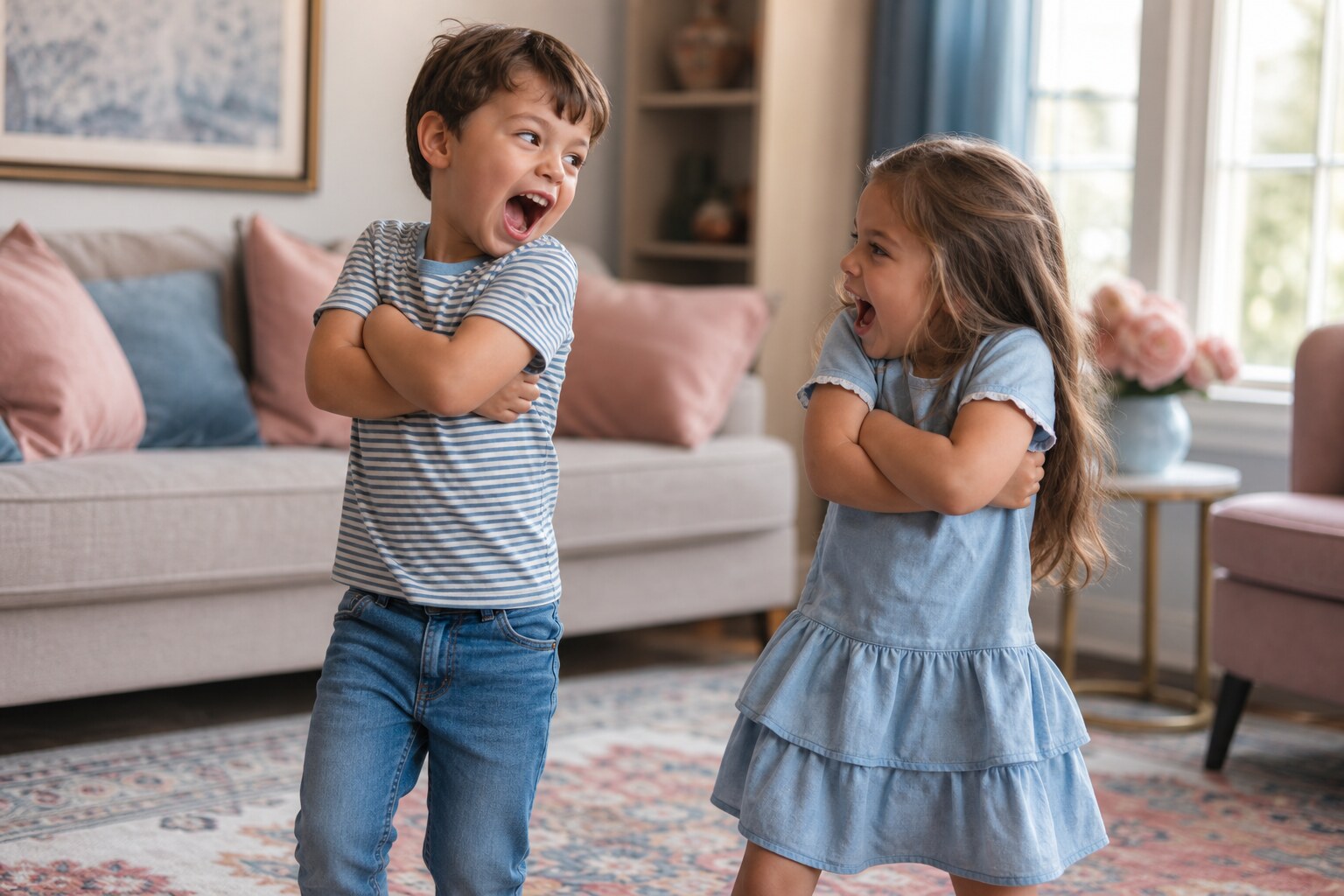
Your child comes home from a playdate talking differently. A new whine in their voice. A sassy "whatever" they've never said before. An eye-roll so precise it looks rehearsed.
You know exactly where it came from — it showed up the same week as a new best friend. And now you're stuck wondering whether to say something to the other parent, ban the playdates, or just wait it out.
Here's the reassuring part: this is one of the most well-documented, most normal things that happens in early childhood. It's also very fixable, once you understand why it's happening.
Kids are wired to copy the people around them
This isn't a character flaw in your child. It's how young brains are built to learn. Psychologist Albert Bandura's classic research found that children imitate behavior they observe, even without any reward for doing so — they don't need to be told to copy something to pick it up.[1] A model just needs to catch a child's attention, and a peer close in age is one of the most attention-grabbing models there is.
Peers specifically — not just parents and teachers — are one of the biggest influences on how young children talk and act. Even three- and four-year-olds reliably copy behavior they see other children do, sometimes down to oddly specific details.[2] In preschool classrooms, this shows up in something researchers can actually measure: children's language and social skills shift to look more like the peers they spend the most time with.[4] [5]
So the whine, the eye-roll, the new comeback — your child isn't rebelling. They're doing exactly what young children are built to do: absorbing the social world around them, fast.
Why it's this friend, specifically
There's a second piece worth knowing, because it explains why some friendships seem to bring out more of this than others. Researchers call it homophily — children don't just copy whoever's nearby, they gravitate toward peers who are already a bit like them, and that mutual pull can amplify shared behaviors over time.[3]
In practice, that means if your child has been a little whiny, a little quick to talk back, a new friend with the same tendency won't just add to it — the two of them will likely reinforce it in each other, each modeling it a little more convincingly for the other.
This is useful to know, because it reframes the question. It's rarely "this one bad kid is corrupting my child." It's closer to "two kids who already lean the same way found each other, and now they're practicing it together."
Why banning the friendship usually isn't the fix
It's tempting to quietly steer your child away from the friend where the whining started. For habits like this — as opposed to genuine safety concerns — that's usually more effort than it's worth, for two reasons.
First, the specific friend is rarely the only source. If your child is in a habit-copying phase, the next friend, the show they're watching, or a cousin at a family gathering will supply the same material. Second, kids at this age move through phases together, and phases move on together too — the whine that feels permanent in October is often gone by December, once the peer group moves on to the next thing.
The more durable fix is addressing the behavior directly, wherever it shows up, rather than trying to control which child your kid spends time with.
What to do instead
Name it without the blame. "That's a new voice — I don't think that's really you talking. Can I hear your regular voice?" This treats the behavior as a costume your child tried on, not a character flaw, and gives them an easy way to drop it without losing face.
Give them the words for what they actually want. A lot of copied "attitude" is really just a new-sounding way to express an old feeling — frustration, wanting control, wanting to seem grown-up. "It sounds like you're really annoyed I said no. You can tell me that without the eye-roll."
Resist the urge to react big. Kids test-drive new behaviors partly to see what happens. A strong, dramatic reaction is often more interesting to a child than the behavior itself, which can accidentally reward the very thing you're trying to reduce. A calm, boring response usually starves it out faster than a big one.
Talk about it outside the moment, not during it. Bring it up later, when nobody's mid-eye-roll: "I noticed you've been saying 'whatever' a lot since you started hanging out with Priya. Where did that come from?" Curiosity, asked calmly later, gets further than correction in the heat of the moment.
Give the good version of the friendship room to work too. The same peer influence that spreads a whine can spread kindness, sharing, and confidence just as easily.[1] Point out — out loud — the moments the friendship brings out something you like: "You were so patient teaching Priya that game today." You're not fighting the friendship. You're aiming it.
Frequently asked questions about kids copying friends' bad habits
Why does my child suddenly talk back after spending time with a certain friend?
Young children are wired to imitate peers, often without even meaning to — it's one of the primary ways they learn social behavior at this age. A new friend with a strong personality or a habit like talking back gives your child a fresh model to copy, and that copying can happen within days.
Should I stop the playdates with the friend who started it?
Usually not necessary for behavior like whining or backtalk, as opposed to real safety concerns. The habit rarely has just one source, and cutting off the friendship can cost you more in trust than it fixes in behavior. Addressing the behavior directly tends to work better than managing the friend list.
Why do two kids with the same bad habit seem to make each other worse?
Children tend to seek out peers who are already a bit like them, a pattern researchers call homophily. When two kids share a tendency — like whining or backtalk — spending time together can reinforce it in both of them, since each one is modeling it for the other.
Will this phase actually pass on its own?
Often, yes — kids move through behavioral phases in groups, and when the peer group moves on, the behavior usually fades with it. Naming the behavior calmly and giving your child an easy way to drop it tends to speed that process up rather than dragging it out.
How do I correct the behavior without blaming the friend?
Focus on the specific behavior in your own child, not the other child's character. "That's a new voice, I don't think that's you" addresses the copied behavior directly without putting your child in the position of defending their friend.
Related reading
- When Your Child Befriends the "Bad Influence" — For when the concern is bigger than a copied phrase or a whine.
- Your Toddler Isn't Being Bad. Their Brain Just Isn't Finished Yet. — More on how young brains pick up and practice new behaviors.
Sources & further reading
Social learning and imitation
- Bandura's Bobo Doll Experiment on Social Learning — Simply Psychology
- The influence of peers on the tendency of 3- and 4-year-old children to over-imitate — Journal of Experimental Child Psychology
Why it's this friend specifically
Peer effects in preschool classrooms
Want more articles like this, every week?
Research-backed parenting tips, straight to your inbox. No spam, unsubscribe anytime.