On the first night of Ramleela, in towns and villages all across India, drummers tap out the very first beat of a story that is thousands of years old. Tonight, we begin it too.
Long, long ago, in the golden city of Ayodhya, beside the calm and shining river Sarayu, there lived a king named Dasharatha. He was kind, and fair, and deeply loved by his people — but one wish sat quietly in his heart, unanswered for many years. He and his three queens, Kausalya, Kaikeyi, and Sumitra, longed for children to fill the palace halls with small footsteps and smaller giggles.
King Dasharatha did not grumble about his wish. Instead, he waited, and hoped, and one day he asked his family's wise old teacher, Sage Vasishtha, for guidance.
"A wish held with patience and a good heart," said Vasishtha gently, "always finds its way to being answered."
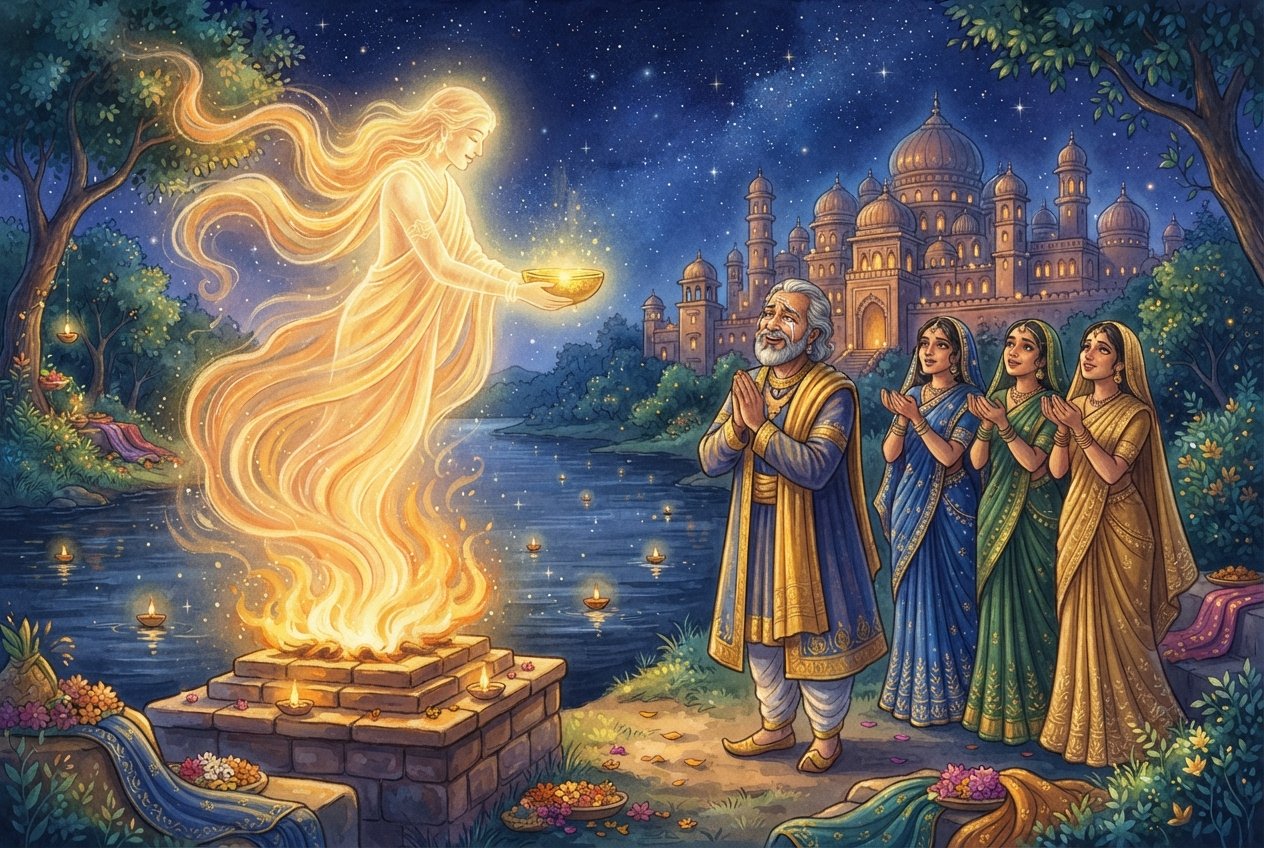
So a great fire-prayer was arranged. A holy sage named Rishyashringa came to lead it, and for many days, soft chants rose over the crackling flames on the riverbank while flower petals drifted through the air.
On the final evening, the fire blazed brighter than any lamp in the kingdom — and from its heart stepped a glowing figure, carrying a golden bowl of warm, sweet kheer.
"Share this among your queens," the figure said kindly, "and your wish shall be granted."
The king's eyes filled with joyful tears as he divided the kheer: a share for Kausalya, a share for Kaikeyi, and — since her portion was doubled — two shares for gentle Sumitra.
Months later, when spring returned to Ayodhya, four baby princes arrived to fill the palace with noise and light, like four new lamps lit all at once. Kausalya's son was named Rama, "the one who brings joy." Kaikeyi's son was named Bharata, "the one who cares for others." And Sumitra, blessed with twins, welcomed Lakshmana and Shatrughna.
The whole city celebrated for days. Musicians played in the streets, sweets were shared with strangers, and King Dasharatha handed out gifts to rich and poor alike, his heart too full to stay still.
Among the four brothers, a very special bond formed early. Baby Lakshmana, it's said, would not stop crying — until his cradle was moved beside baby Rama's. The instant their hands touched, Lakshmana sighed happily and fell fast asleep. From that day on, wherever Rama went, Lakshmana followed close behind, and Bharata and Shatrughna shared the very same kind of closeness.
As the princes grew, Rama became known through the kingdom for something quieter than strength or cleverness — for his gentle patience, and for a smile that made even strangers feel instantly at ease.
"Sleep well, my sons," King Dasharatha would whisper each night, looking in on his four sleeping princes by lamplight. "You were wished for with a patient heart, and patience always makes the sweetest things worth waiting for."
And so, on this first night of our own nine-night journey, the very first lamp is lit. Old Sage Vasishtha lingered a moment longer than the others beside baby Rama's cradle, watching the infant's small fist close tight around his finger — and felt, without quite knowing why, a quiet certainty that this particular lamp had been lit for something far bigger than anyone in the palace yet imagined.
Tomorrow: Night Two, when two of these little princes are asked to guard something far more important than gold.
The End — of Night One