On the second night of Ramleela, the drummers beat a little faster, because tonight, two young princes leave home for the very first time.
Years had passed since the four little princes filled the palace with laughter. Rama and Lakshmana were no longer babies — they were bright-eyed boys, quick with a bow and quicker with kindness. One day, a tall sage named Vishwamitra arrived at the palace gates, his eyes calm and serious.
"I am holding a sacred fire-prayer deep in the forest," he told King Dasharatha, "and I need two brave, good-hearted helpers to guard it. I ask for your sons, Rama and Lakshmana."
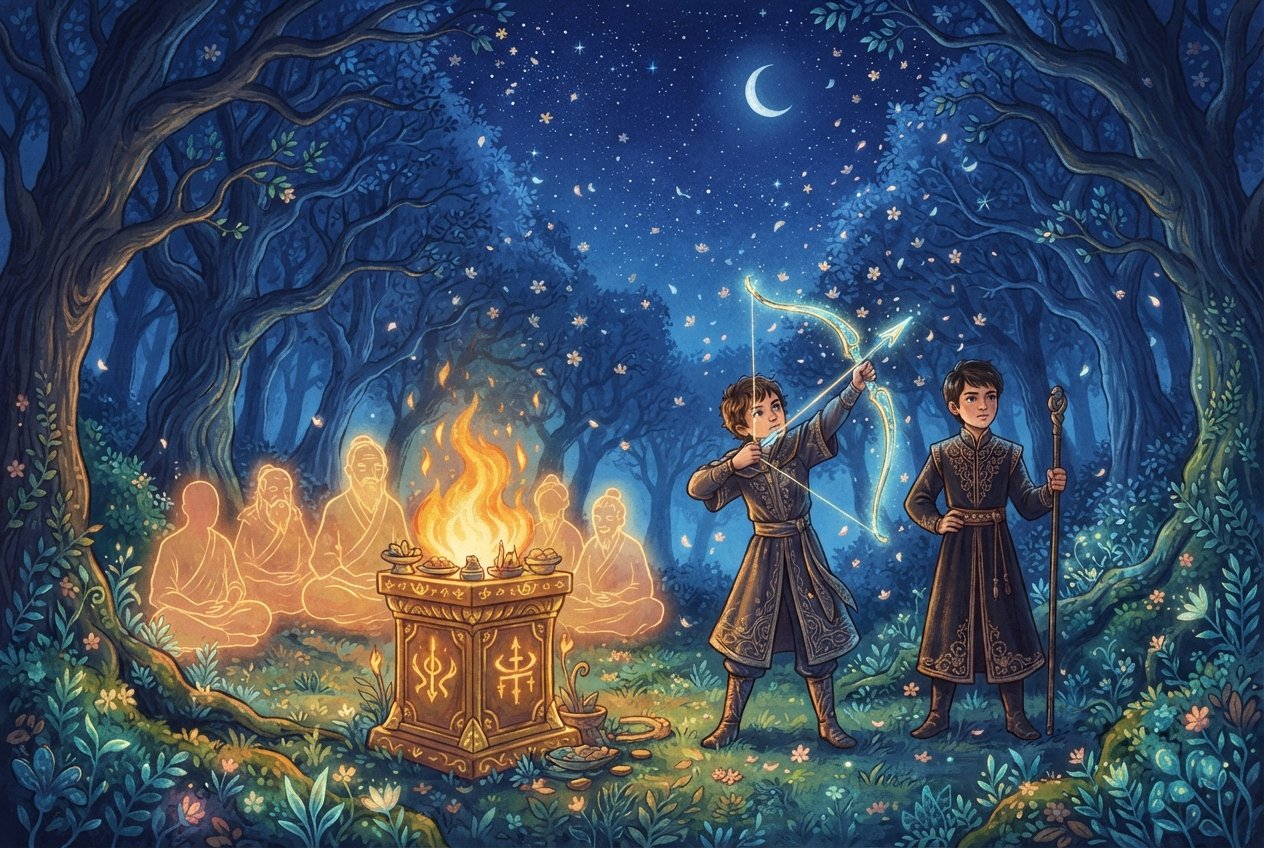
The king's heart clenched with worry — but he trusted the wise sage, and he trusted his sons even more. So the two young princes bowed to their father and followed Vishwamitra into the forest, past rivers and under leaning trees, until they reached a peaceful clearing where sages sat chanting around a golden fire.
"For six nights, this fire must not be disturbed," Vishwamitra explained. "But on the final night, mischief-makers often come to spoil it. Will you two keep watch?"
"We will, Guruji," said Rama, resting a steady hand on his bow. Lakshmana nodded, standing tall beside him.
Five nights passed quietly, the fire glowing warm and gold beneath the stars. But on the sixth night, the wind turned cold, clouds rolled in, and down from the sky swooped two noisy troublemakers named Maricha and Subahu, hooting and flinging mud toward the sacred flame.
Rama did not shout or panic. "Lakshmana," he said calmly, "keep the circle safe." Then he drew his bow — twang! — and with one gentle, well-aimed arrow, sent Subahu tumbling far over the treetops. A second, softer arrow scooped up Maricha like a gust of wind and carried him all the way out to sea, where he landed with a splash and decided, dripping wet, that spoiling fire-prayers was simply not worth the trouble.
The clouds cleared. The fire burned steady again. And as dawn touched the sky pink and gold, flowers drifted down from above, as if the heavens themselves were applauding.
On their way back toward Mithila, the sages led the boys past a strange, silent stone in a quiet grove — said to hold a soul who had been still and sorrowful for a very long time. When Rama knelt and touched the stone with gentle care, it began to glow — and slowly, warmly, a woman named Ahalya rose from it, freed at last, her sadness melting into a soft, grateful smile.
"Kindness," Vishwamitra told the two princes, "can wake up even the parts of the world that have been sleeping the longest."
That night, resting beside the embers of the finished fire-prayer, Rama and Lakshmana finally allowed themselves to rest — two young guardians who had learned, in a single journey, that real bravery is quiet, and real kindness can undo even old, old sorrow. Before they slept, Vishwamitra mentioned, almost as an afterthought, that their road home would pass through a kingdom called Mithila, where an ancient bow lay waiting that no living person had ever managed to lift. Rama sat up a little straighter at that. Neither he nor Lakshmana could have guessed yet how much that one small detour was about to change everything.
Tomorrow: Night Three, when a bow that no one else can lift finds exactly the right hands.
The End — of Night Two