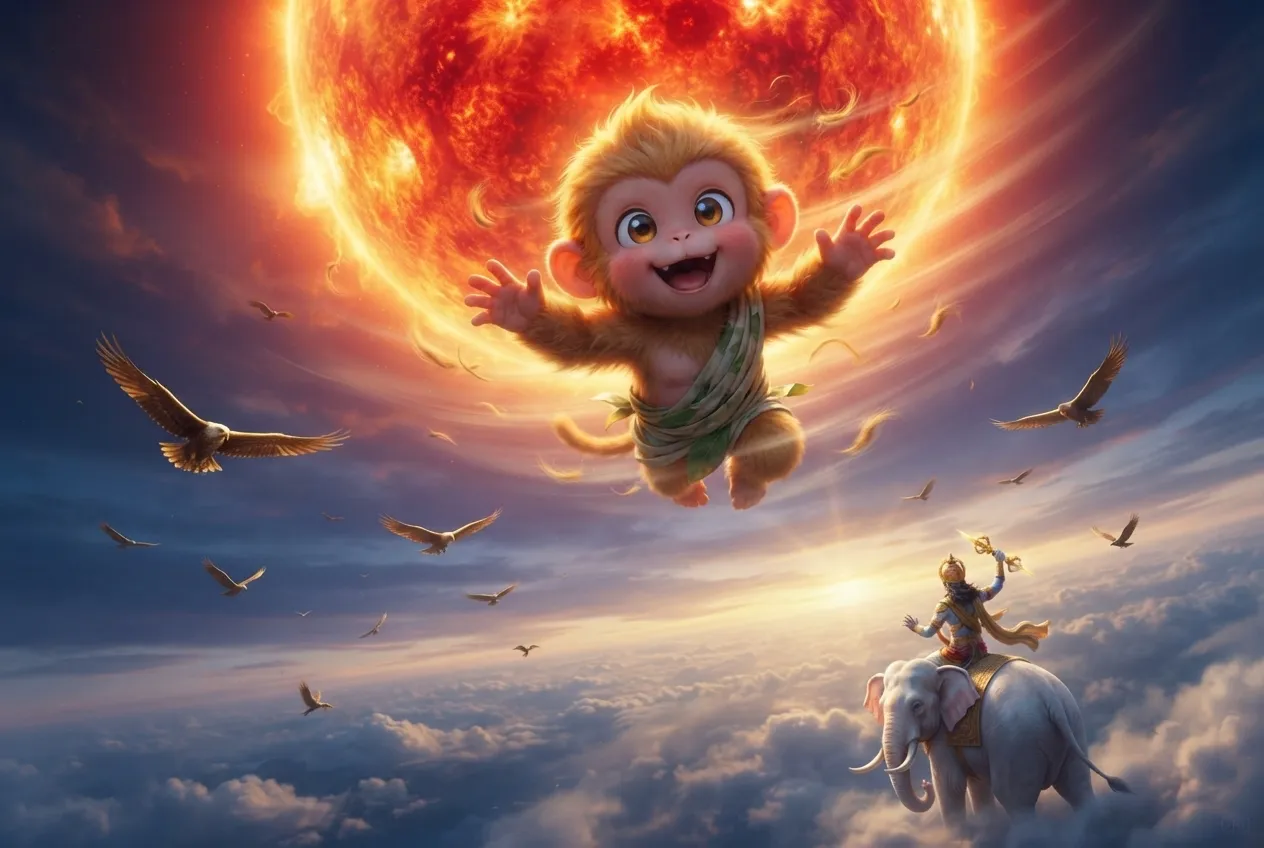
The Story of How Hanuman Got His Name
In the forested hills where baby Hanuman had been born, mornings were quiet and slow. Every day, before the sun was fully awake, Anjana would settle her little son on a soft bed of leaves beneath the old banyan tree.
"Stay right here, my darling," she would say, kissing his forehead. "I will return before the sun climbs too high."
One particular morning, baby Hanuman woke earlier than usual, his tiny tummy rumbling with hunger. He looked around for his mother, but she had already gone to gather fruit for their breakfast. He waited a little while, kicking his chubby legs and babbling softly to the birds hopping near him.
But as the minutes passed and his hunger grew, his patience wore thin. He rubbed his eyes and looked up at the sky, searching for something — anything — to fill his little belly.
That was when he saw it.
Rising slowly over the eastern hills was a great, glowing, perfectly round shape, blazing in the most brilliant red-orange he had ever seen.
"Oh!" Hanuman gurgled with delight, reaching his chubby arms toward the sky. "A big, juicy fruit!"
For to a hungry baby who had never once seen a sunrise, the great sun looked exactly like the most enormous, ripest fruit imaginable — glowing red-gold and irresistible against the pale morning sky.
Without a second thought, baby Hanuman gathered all his strength, kicked his little legs with all his might, and leapt.
It was no ordinary leap. As the son of Vayu himself, he soared upward with astonishing speed — higher than the tallest trees, higher than the circling eagles, higher than the clouds — racing eagerly toward the glowing "fruit," giggling with joy the whole way up.
Down below, the wind rushed past so fast that birds scattered in surprise, and Anjana, gathering fruit nearby, felt a great gust sweep through the trees. She looked up in alarm to see her baby son soaring impossibly high into the heavens.
"Hanuman!" she cried out, though her voice could never reach him at such a height.
High above the earth, the great god Indra, King of the Heavens, was riding across the sky on his magnificent white elephant, surveying the world below. He was startled to see a baby, of all things, hurtling straight toward the sun with outstretched arms and a delighted grin.
"A child, flying toward the sun?" Indra gasped. "He will be burned if he reaches it! I must stop him!"
Acting quickly out of concern, Indra raised his mighty thunderbolt, the Vajra, and sent a small, careful bolt toward the little flyer — not to hurt him badly, only to knock him gently off his dangerous path before he came any closer to the sun's tremendous heat.
The bolt tapped baby Hanuman softly on his little chin, just enough to startle him. He tumbled slowly back down through the clouds, his surprised cry echoing across the sky.
Far below, his father Vayu felt his son's distress at once. Like a mighty gust, he swept in and caught baby Hanuman safely in his arms before he ever touched the ground.
But when Vayu saw a small red mark on his son's chin, a fierce, protective fire rose in his heart. "Who has dared to harm my child?" he roared — and in his fury, he pulled his breath back from the entire world, refusing to blow even the gentlest breeze anywhere on earth.
Within moments, everything grew strangely still. Leaves stopped rustling. Not a whisper of wind moved anywhere in the three worlds. And without Vayu's breath, every living being — humans, animals, even the gods — began to struggle for air.
The gods gathered at once, alarmed, and hurried to find Vayu. They found him deep in a mountain cave, gently rocking his whimpering son, refusing to return until his child was honoured and safe.
Indra arrived first, his heart heavy. "Vayu, old friend, forgive me," he said softly, kneeling beside them. "I saw only a baby flying dangerously close to the sun, and I acted only to save him from far greater harm. Look — the mark is already fading."
And it was true. When Vayu looked closely, the little mark was healing fast, and baby Hanuman, no longer crying, was already reaching curiously for Indra's glowing thunderbolt, utterly unafraid.
Vayu's anger melted. The other gods, moved by how fiercely a father could love his child, decided that such an extraordinary baby deserved truly extraordinary gifts.
Brahma, the creator, stepped forward first. "Because of this small mark upon his hanu — his chin — this child shall be known through all the worlds as Hanuman. And I grant this: no weapon shall ever seriously harm him again."
Surya, the sun he had so boldly tried to eat, laughed warmly. "Any child brave enough to leap for the sun deserves to understand it. When he is old enough, I myself shall be his teacher."
Indra, still gentle with guilt, added, "My thunderbolt caused this small hurt — so let it also give a gift. Hanuman shall change his size at will, growing as vast as a mountain or as small as a mouse, whenever the need arises."
One by one, the gods gathered in the cave gave their blessings — great strength, incredible speed, endless courage, and a heart devoted always to serving others before himself.
Anjana arrived moments later, breathless from searching, and swept her giggling baby into her arms, tears of relief on her face. "My darling Hanuman," she whispered, using his new name for the very first time, "you tried to eat the sun today. What a brave, foolish, wonderful boy you are."
Baby Hanuman only gurgled happily, already reaching for a butterfly fluttering nearby — utterly unaware of the extraordinary blessings now woven quietly into him, waiting patiently for the day, many years later, when the world would need them most.
Fun Fact: This is how Hanuman got his name — from hanu, meaning chin or jaw, the very spot where Indra's thunderbolt left its gentle mark.
Even the smallest mishap can carry a hidden gift. Hanuman's tumble from the sky became the very moment he was truly named — and truly blessed.
The End