The Story of the Gentle Curse
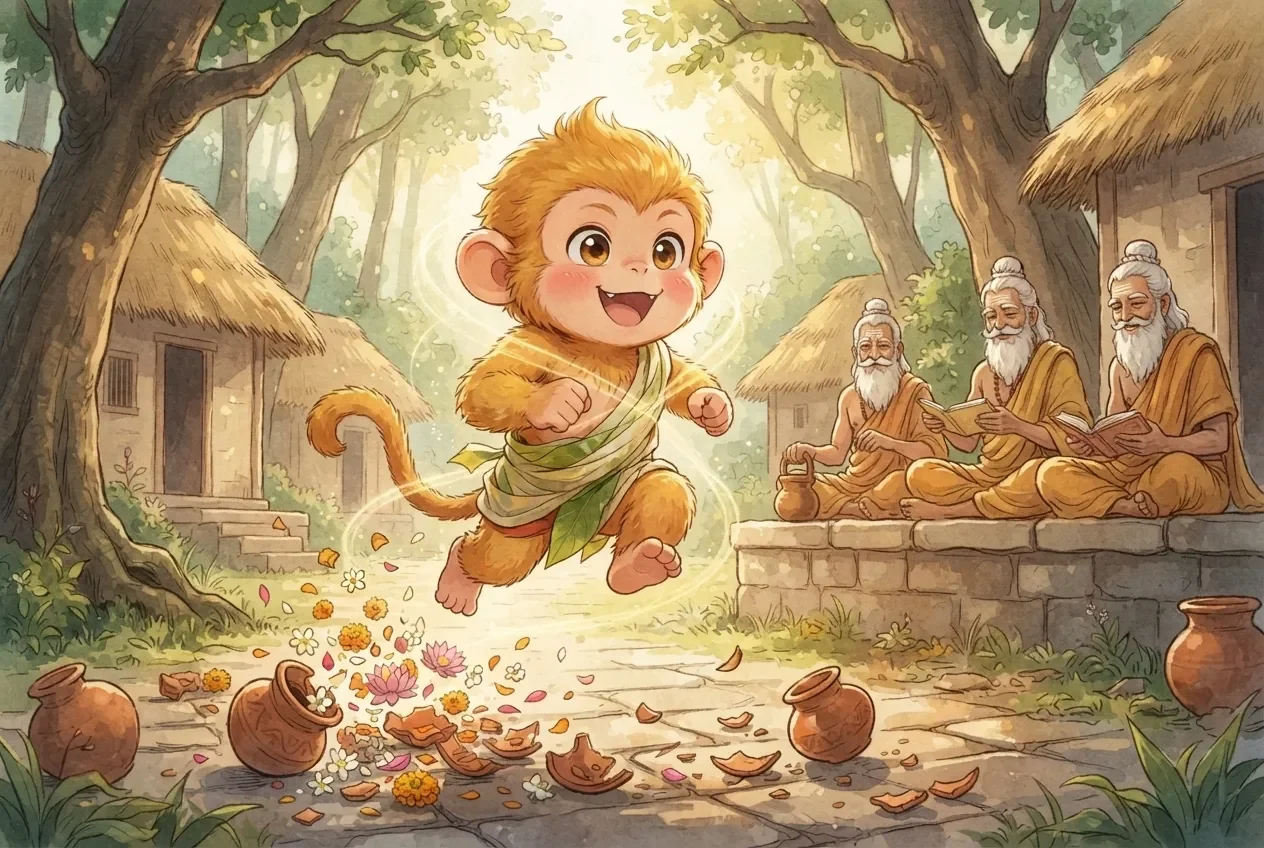
As Hanuman grew from a baby into a small, bouncy child, one thing became very clear: he could not sit still. Blessed with the wind's own speed and strength, he zipped through the forest like a golden streak of light, swinging from vine to vine, leaping over streams in a single bound, and laughing louder than anyone had ever laughed before.
It was wonderful — most of the time.
But deep in the same forest lived a group of quiet, elderly sages, who had built their peaceful hermitage among the trees. Every morning, they lit sacred fires, filled their clay pots with fresh water, and sat in deep, silent meditation for hours.
And every morning, without fail, a small golden blur came crashing through.
"Whoosh!" Hanuman would swing past on a low branch — and knock over three water pots at once.
"Splash!" He would land right in the middle of their offering bowls, scattering flower petals everywhere.
"Whee!" He would tug playfully at a sage's long white beard, giggling, before darting off before anyone could catch him.
He never meant any harm. To Hanuman, it was all a wonderful game — the sages sitting so still seemed like the perfect thing to gently interrupt. He didn't yet understand how much quiet and care their prayers needed, or how tired their old hands were from remaking what he broke, over and over again.
One especially clumsy morning, Hanuman came racing through at full speed, tripped over a sage's meditation mat, and sent an entire row of clay pots crashing down the hill — clink, clink, CRASH — every single one shattering into pieces.
The sages sighed. They loved the little vanara's joy and his bright, fearless heart. But they knew that a child with so much power, and so little understanding of it yet, could one day cause far greater harm without ever meaning to.
So the wisest among them called Hanuman gently to sit before them.
"Little one," the old sage said, not with anger, but with a soft, caring smile, "you carry more strength inside you than you know. One day, that strength will be needed to do something wonderful — something the whole world will remember. But if you carry all of it now, before you understand it, you might grow careless, or proud, without meaning to."
Hanuman tilted his head, listening carefully, his mischief melting into curiosity.
"So we give you this gift," the sage continued, "though it may feel, for now, like a puzzle. From this day, you shall forget the true size of your own power. You will grow up strong, and kind, and clever — but gentle, too, never knowing just how mighty you truly are. And you shall stay that way, until one day, someone who loves you and believes in you reminds you of who you really are. In that very moment, your full strength will awaken again — at exactly the moment the world needs it most."
A soft golden light shimmered around Hanuman for just a heartbeat, and then faded, as quiet and gentle as a falling leaf.
Hanuman blinked, and somehow, though nothing about him looked different, something inside him felt a little lighter — a little more humble.
"I'm sorry about your pots," he said quietly, and this time, he meant it with his whole heart.
The old sage smiled and patted his head. "There is nothing to forgive, little one. You have not lost anything today. You have only been given the greatest gift of all — the chance to grow up wondering, working, and wandering, before the world hands you its heaviest task. Great strength grows best in someone who has learned, first, to be humble."
From that day on, Hanuman still ran through the forest, still climbed the tallest trees, still made the birds laugh with his games. But something had changed, quietly, deep inside him. He no longer thought of himself as the strongest, the fastest, or the mightiest.
He simply thought of himself as Hanuman — a curious, kind-hearted boy, with a secret, sleeping strength, patiently waiting for the day someone would help him remember.
Fun Fact: In the old stories, this gentle "curse" wasn't a punishment at all — it was a blessing in disguise, meant to protect Hanuman from growing proud before he was ready for his true purpose.
Sometimes, being told "not yet" is really someone saying "I believe you're capable of something even bigger — when the time is right."
The End