The Story of Mahabali and the Three Steps
Long ago, in a land of green rice fields, tall coconut trees, and rivers that shone like silver, there lived a king named Mahabali.
Everyone called him Maveli.
King Mahabali was strong, wise, and kind. He did not sit in his palace all day wearing jewels and giving orders. He walked through villages. He listened to farmers, fishers, potters, and children.
If someone was hungry, food was shared.
If someone was lonely, neighbors visited.
If someone was treated unfairly, King Mahabali listened carefully and made things right.
Under his rule, people said there was no cheating, no stealing, and no sadness that lasted too long.
The land became prosperous. The barns were full. The lamps were bright. The songs were loud. And every house, rich or poor, had enough to eat.
People loved King Mahabali deeply.
"Maveli is not just our king," they said. "He is one of us."
But far away in the heavens, the devas watched.
Some of them began to worry.
"Mahabali has become too powerful," they said. "Everyone praises him. His kingdom grows greater each day."
So the devas went to Lord Vishnu, the protector of the world.
"Please help us," they said. "Mahabali is generous, but his power is spreading everywhere."
Lord Vishnu listened.
He knew Mahabali was not cruel. He knew the king loved his people. But he also knew that even good kings must learn humility, because pride can grow quietly in any heart.
So Lord Vishnu chose a gentle way.
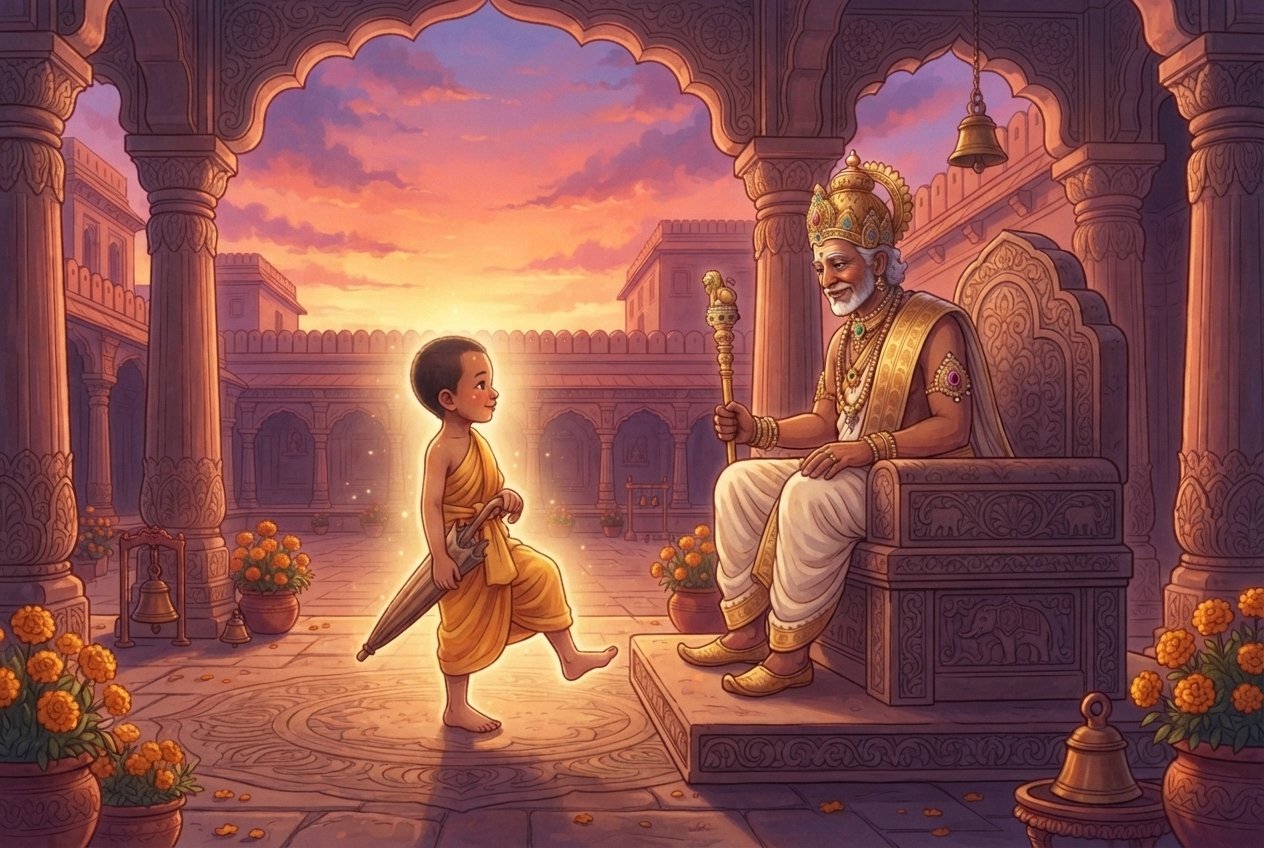
He came to earth as a small boy named Vamana.
Vamana was a young Brahmin boy with bright eyes, a wooden umbrella, and tiny feet. He looked simple and harmless. But inside him was the power of the universe.
One morning, King Mahabali was performing a great yajna, a sacred ceremony. Priests chanted. Lamps burned. Gifts were given to anyone who came.
Gold, cows, land, food, clothes, jewels: Mahabali gave freely.
"No one should leave my hall empty-handed," said the king.
Just then, little Vamana entered.
He walked slowly, holding his umbrella. The whole hall grew quiet, though no one knew why.
King Mahabali rose from his throne.
"Welcome, young one," he said kindly. "What do you need? Ask me for anything."
Vamana looked up at the great king.
"I do not need much," he said. "Please give me only three steps of land."
The court burst into murmurs.
"Three steps?" whispered one minister. "He could ask for a village!"
"He could ask for gold!" said another.
Mahabali smiled. "Child, your feet are very small. Ask for more. I can give you fields, elephants, palaces, or treasure."
Vamana shook his head. "Three steps of land are enough for me."
King Mahabali laughed warmly. "Then three steps you shall have."
But Mahabali's teacher, Shukracharya, stepped forward quickly.
"My king," he warned, "this is no ordinary boy. I sense great power in him. Be careful. Once you promise, you cannot take it back."
King Mahabali looked at Vamana.
The boy stood quietly, with his small umbrella and shining eyes.
Then the king looked at the people around him.
"I have given my word," Mahabali said. "A promise must be kept, even when it is difficult."
He poured water into Vamana's hands, sealing the gift.
At that moment, the small boy began to grow.
He grew taller than the palace pillars.
Taller than the palm trees.
Taller than the mountains.
His umbrella became like the sky. His eyes glowed like the sun and moon. His body stretched across the universe.
The court gasped.
The little boy was Lord Vishnu.
With his first step, Vamana covered the whole earth.
With his second step, he covered the heavens.
Then he looked at Mahabali.
"Great king," said Vamana, "you promised me three steps of land. I have taken earth and heaven. Where shall I place my third step?"
The hall was silent.
Mahabali understood.
He had owned nothing, not really. The land, the sky, the rivers, the harvest, even his power as king: all of it belonged to something greater.
Slowly, Mahabali removed his crown.
He folded his hands and bowed his head.
"My Lord," he said, "I have no land left to give. Place your third step upon me."
Everyone began to cry.
The people loved their king. They did not want him to leave.
But Mahabali was calm.
"A promise is a promise," he said. "And truth is greater than a throne."
So Vamana placed his third step upon Mahabali and sent him to the world below, called Patala.
But Lord Vishnu was pleased.
Mahabali had lost his kingdom, but he had shown courage, honesty, and devotion. He had kept his word. He had bowed not from fear, but from wisdom.
So Vishnu blessed him.
"Mahabali," he said, "your people love you, and you love them. Once every year, you may return to earth and visit your kingdom."
Mahabali's face lit with joy.
"May I see if my people are happy?" he asked.
"Yes," said Vishnu. "You may return and see their homes, their fields, their flowers, and their feasts."
And that is why, every year, the people of Kerala celebrate Onam.
They clean their homes.
They lay beautiful pookalams made of flowers.
They cook a grand sadya on banana leaves.
They sing, dance, play games, and watch boat races.
They wear new clothes.
They welcome guests.
And most of all, they remember the good king who loved his people so much that even after leaving the earth, he came back to see them.
On Onam morning, children place flowers at the doorstep.
"Will Maveli come today?" they ask.
Their grandparents smile and say, "If our hearts are kind, he will surely visit."
Some say Mahabali comes like a king, wearing a crown and golden ornaments.
Some say he comes like a traveler, walking quietly from house to house.
Some say he comes as a feeling: the joy of sharing, the warmth of family, the happiness of seeing no one left out.
But however he comes, people prepare with love.
Because Onam is not only a memory of an old kingdom.
It is a promise.
A promise to be generous like Mahabali.
A promise to keep our word.
A promise to welcome everyone.
A promise to remember that greatness is not in how much we own, but in how much we give.
And every year, when the pookalams bloom like circles of sunshine and the smell of payasam fills the air, people say:
"Maveli is coming."
So they open their doors.
They open their hands.
And they open their hearts.
Fun Fact: Vamana's giant form — the one whose two strides measured the whole earth and sky — is remembered as Trivikrama, "the one who took three steps." Kerala's Thrikkakara temple is said to mark the very spot where his foot first touched the ground, which is how the town got its name — "Thrikkakara" means "the place of the sacred foot."
Mahabali kept his promise even when it cost him his crown — and that is exactly why Onam is still celebrated today: not to remember a king who lost his kingdom, but to remember one who never lost his people.
The End