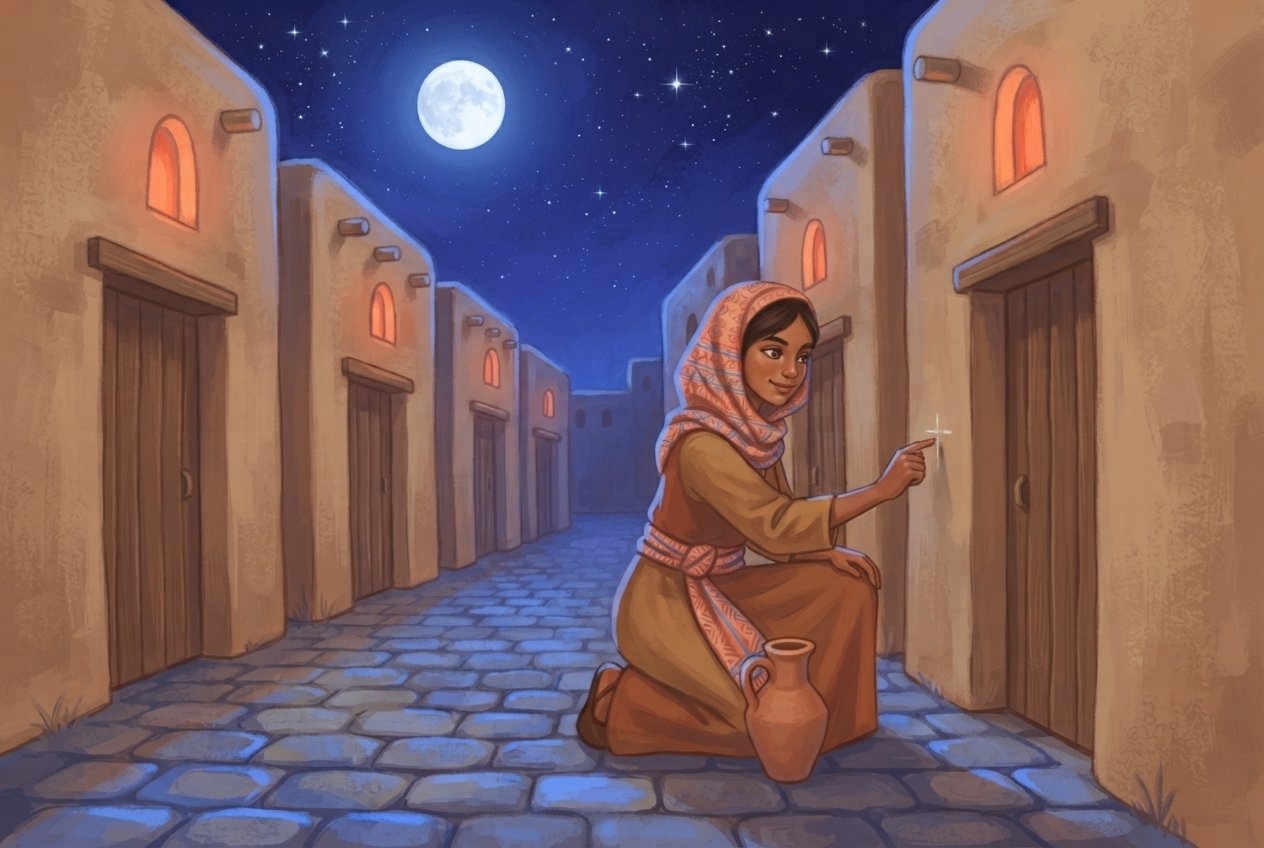
The thief marked Ali Baba’s door with white chalk. Morgiana noticed the mark on her way to market. She did not know what it meant, so she drew the same mark on every door in the street.
That night the captain came to find the marked house. White crosses covered both sides of the road.
He sent a second scout, who used red chalk. Morgiana copied that mark too. At last the captain came himself, studied Ali Baba’s house without chalk, and memorised every window and step.
Then he prepared a different sort of visit.
The thieves’ captain disguised himself as an oil merchant. Nineteen mules carried thirty-eight leather jars to Ali Baba’s house. One jar held oil. A thief hid inside every other jar.
“I am a traveller caught by night,” the false merchant said. “May my mules stand in your courtyard?”
Ali Baba welcomed him to supper and gave him a room. The captain went among the jars before bed.
“When you hear pebbles strike your lid,” he whispered, “climb out.”
Later, Morgiana’s kitchen lamp ran out of oil. A servant suggested taking some from the merchant’s jars.
She lifted the first lid.
“Is it time?” whispered a voice inside.
Morgiana’s hand did not shake. “Not yet,” she answered, copying the captain’s low voice.
She went from jar to jar. Each held a waiting thief. Only the final jar contained oil.
Morgiana heated that oil until it steamed. Quietly, she poured a measure into every jar where a robber hid. The men were overcome before they could climb out. Then she put out her lamp and watched from a window.
Near midnight the captain appeared. He tossed pebbles at the jars.
Tap. Tap. Tap.
No lids moved.
He opened one, then another, and discovered his plan had failed. Without horse or shoes, he slipped over the garden wall and fled.
At dawn Morgiana showed Ali Baba the jars. He understood why white and red marks had appeared on the doors and why an oil merchant had arrived after dark.
Together they secretly buried the robbers beyond the garden and sold the mules in distant markets. Ali Baba wanted to reward Morgiana, but she asked him to remain watchful.
“The captain escaped,” she said. “A snake without its tail can still bite.”
For a year nothing happened.
Then a merchant named Cogia Houssain rented a fine shop opposite the one run by Ali Baba’s son. He sold rich cloth cheaply, gave splendid dinners, and refused every dish containing salt.
Ali Baba’s son liked his generous new friend. He invited the merchant home.
When Morgiana saw the guest’s eyes above his unfamiliar beard, she recognised the captain of the thieves.
Under his robe, she glimpsed the handle of a hidden dagger.