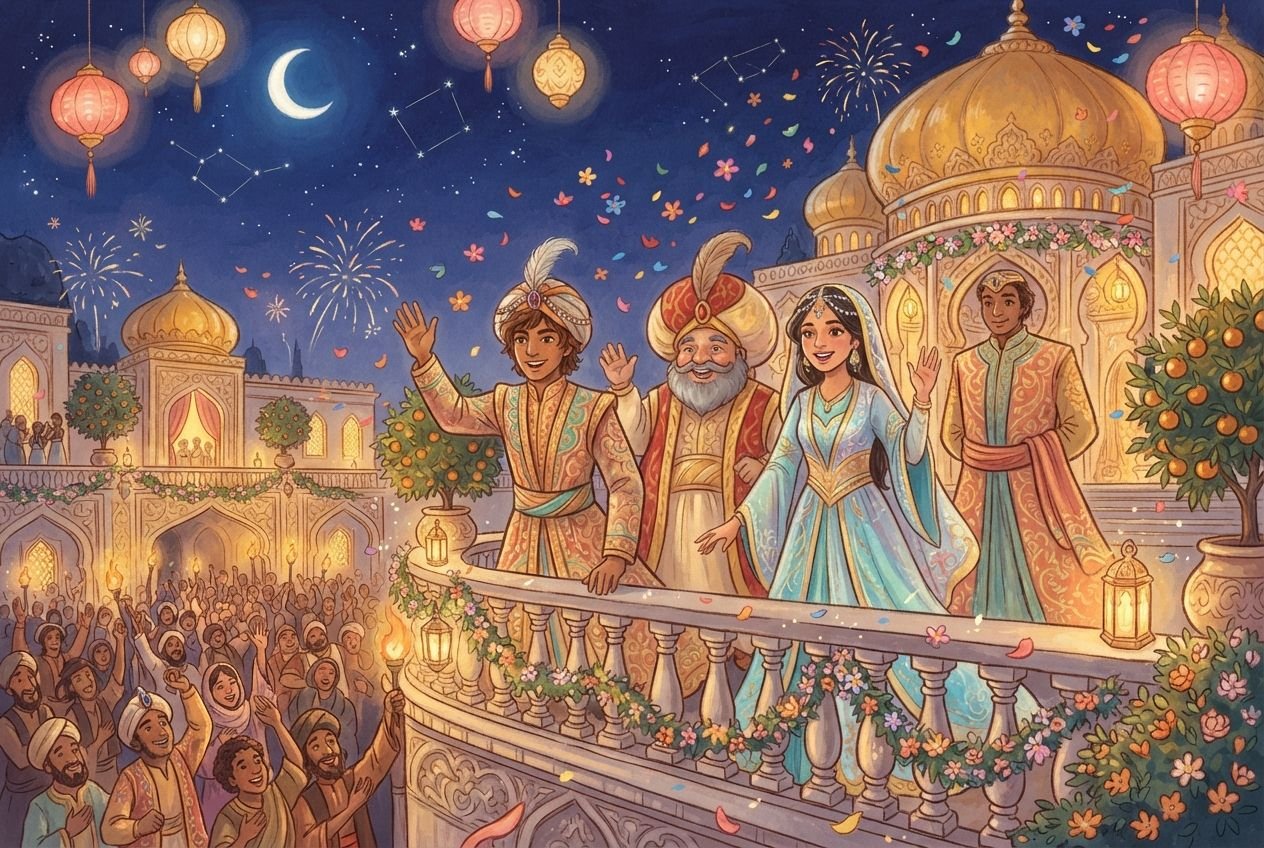
Aladdin entered the palace wearing robes sewn with gold. Behind him came musicians, servants, and horses whose harness bells made the streets sing. He greeted the Sultan with grace, and Princess Badroulbadour found him far more likeable than the mysterious owner of endless jewels she had imagined.
Before the wedding, Aladdin rubbed the lamp.
“Build us a palace beside the Sultan’s,” he told the spirit. “Use marble, jasper, and gold. Make a hall with twenty-four windows, each framed in diamonds and rubies—but leave one window unfinished.”
By sunrise, a palace stood where an empty field had been. A velvet carpet joined it to the Sultan’s door. In the great hall, twenty-three windows blazed like captured rainbows. The last had a plain frame.
The Sultan was amazed. His jewellers offered to finish it. They used every stone in the treasury and begged noble families for more. After weeks of work, the window was not half complete.
“Please take your jewels back,” Aladdin said.
That night the lamp spirit finished the frame. The next morning the Sultan could not tell which window had once been bare.
The wedding filled the city with drums, lanterns, and tables of food. Aladdin and Badroulbadour rode beneath showers of flower petals. His mother moved into rooms so large that she got lost twice before breakfast and began leaving a trail of cushions.
Aladdin became a trusted commander. He rode with the Sultan’s soldiers when trouble threatened the borders and returned to cheering crowds. At home, he and the Princess opened the palace grounds for festivals and heard petitions from the city.
The old lamp remained hidden behind a carved panel in the Princess’s rooms. Aladdin never told her its power. To her it looked like a blackened scrap not worth one copper coin.
Far away in Africa, the magician spread sand on a bronze table and read the stars. He discovered that Aladdin had escaped the cave, kept the lamp, and built a palace.
He smashed his bowl in fury.
Then he packed twelve new copper lamps into a basket, boarded a ship for China, and practised a cheerful street cry all the way across the sea.