A Tale of Birbal's Wit
Long ago, in the city of Agra, stood a great red palace. Its towers reached so high they seemed to touch the clouds. Inside lived Emperor Akbar, a wise king who loved clever minds more than gold or jewels.
Not far away, in a small village by the river, lived a poor young man named Mahesh Das. His family had only a small hut and a few goats. But Mahesh Das had something no one could steal from him — a very quick mind. He could solve riddles that puzzled even the village elders.
"You should go to Agra," his mother told him one evening. "A mind like yours should not be wasted here. Go to the Emperor's court."
So Mahesh Das took a walking stick, a few coins, and his mother's blessing, and set off for Agra.
When he reached the palace, tall guards stood at the gate. Mahesh Das had no letter, no rich family name — only his wit. So every morning, he sat quietly on the palace steps, humming little songs, hoping someone would notice him.
For many days, no one did. But Mahesh Das did not give up.
One afternoon, Emperor Akbar walked past, deep in thought. He had been wondering how to find truly clever people among the many who begged for a place in his court. Something about the calm young man on the steps caught his eye.
"You there," Akbar called. "Why do you sit here every day?"
Mahesh Das stood and bowed. "Only for a chance, Your Majesty. A chance to show that a clever mind can come from anywhere."
A proud minister named Todar Mal laughed behind his hand. "Just another beggar with big words. Send him away."
But Akbar raised his hand for silence. An idea had come to him — a test.
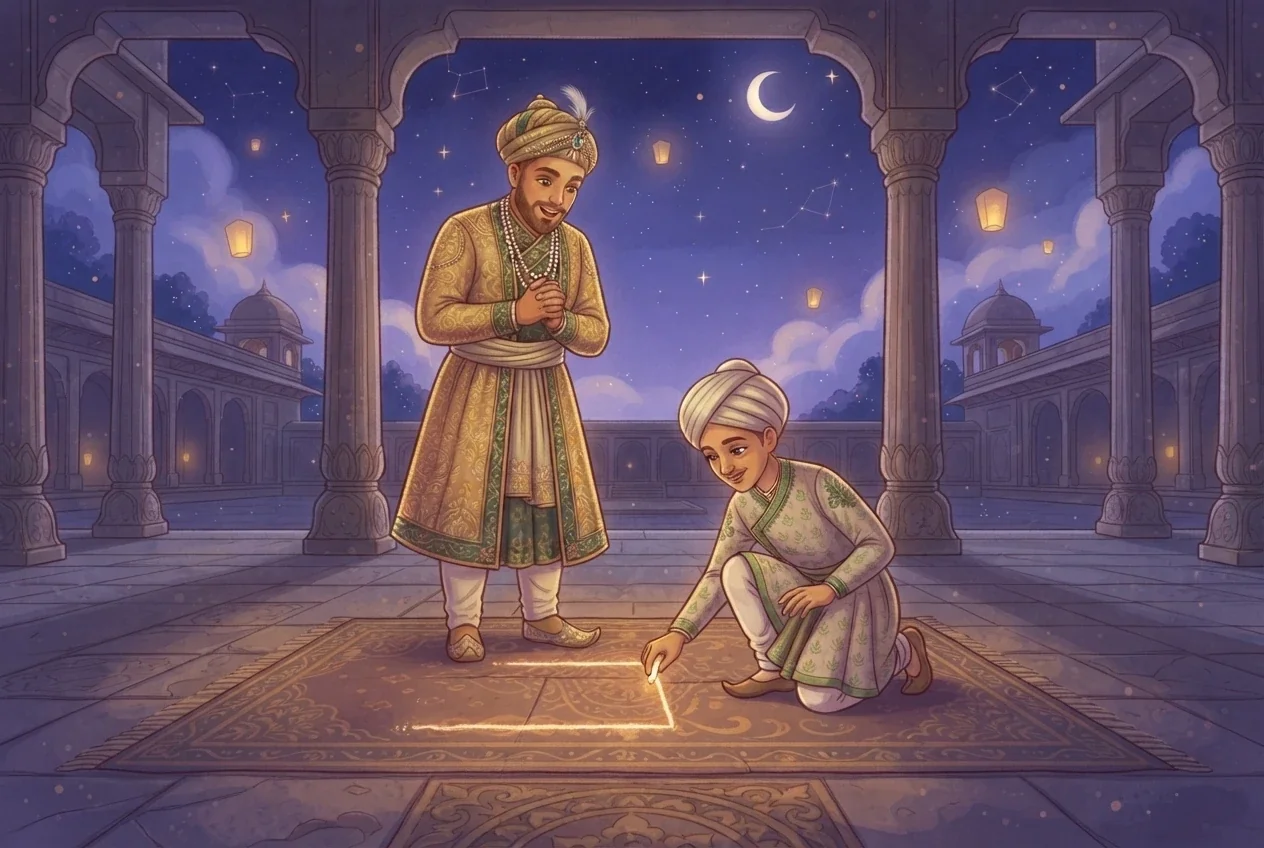
The Emperor bent down and drew a single straight line on the stone floor with a piece of chalk. "Make this line shorter," he said, "without touching it. Do not erase even one speck of it. If you can do this, you shall have a place in my court."
The whole courtyard went quiet. How could anyone make a line shorter without touching it at all?
Mahesh Das looked at the line for only a moment. Then he took the chalk and, without touching the Emperor's line, drew a second line right beside it — a much longer one.
"It is done, Your Majesty," he said, bowing.
Akbar frowned. "I asked you to make my line shorter. You have not touched it at all."
Mahesh Das smiled. "Forgive me, but look again. Your line has not grown shorter in itself. Yet next to this new, longer line — does it not look smaller than before?"
The whole courtyard stared. It was true. Without touching a single speck of chalk, Mahesh Das had made the line look shorter — simply by changing what stood beside it.
Akbar threw back his head and laughed with delight. "Cleverness," he said, "does not always mean changing the thing in front of you. Sometimes it means changing how you look at it. Rise, Mahesh Das — no, rise, Birbal, for that is what I shall call you from today. You shall have a place at my court."
And so Mahesh Das, the poor boy who came to Agra with nothing but a walking stick, became Birbal — the Emperor's most trusted friend and minister, whose clever answers would help solve puzzles and settle quarrels for many years to come.
His mother, they say, never had to worry about an empty bowl again.
"A clever mind does not always solve a problem by changing it — sometimes, it solves it by changing the way we look."
The End